ENVIRONMENTAL SCIENCE · CHAPTER 5
Species Interactions Lab
Follow along with your worksheet, one question at a time.
mrsajdak.com/interactions
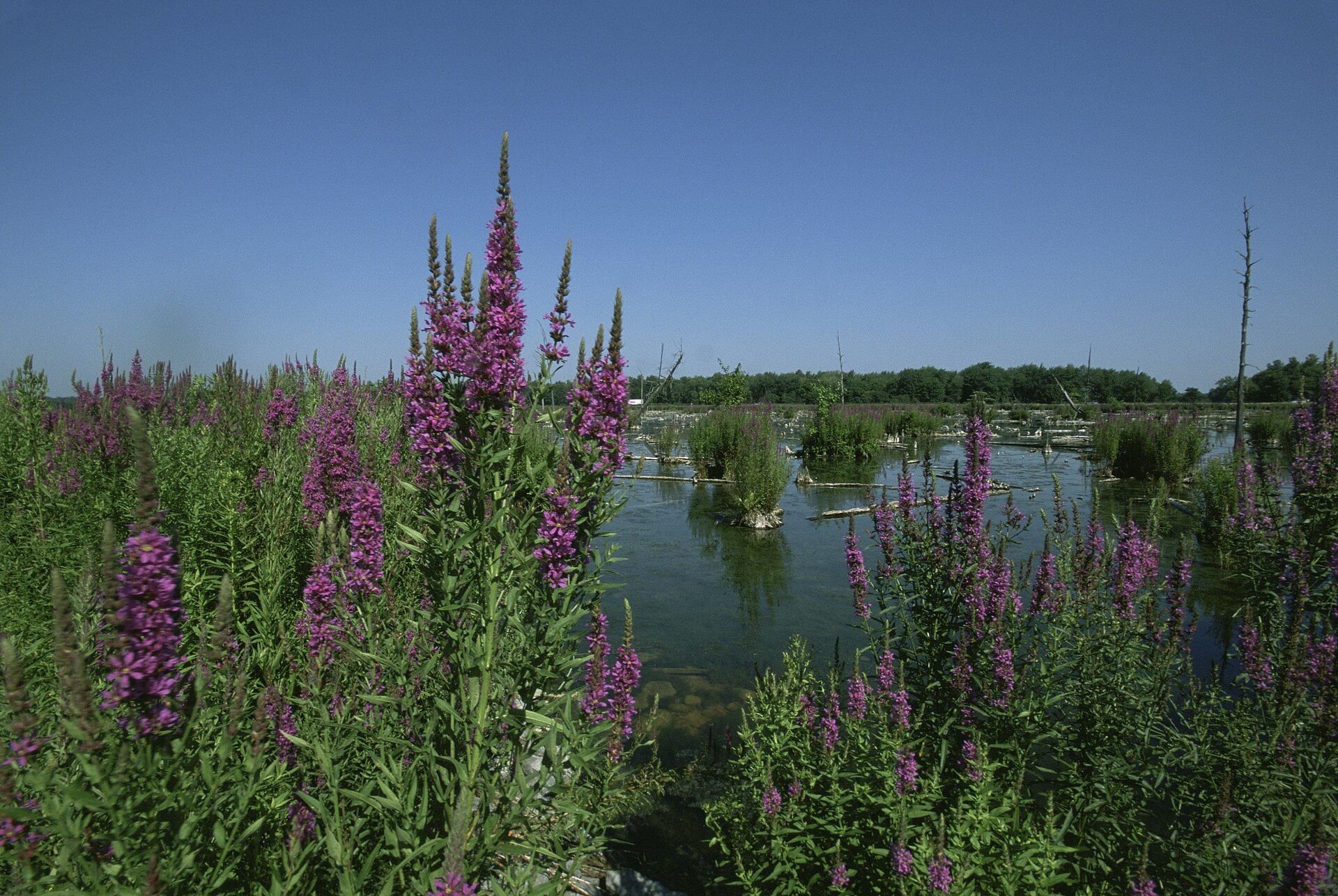
Photo: Jim Hudgins, U.S. Fish and Wildlife Service
BEFORE YOU START
No species lives alone
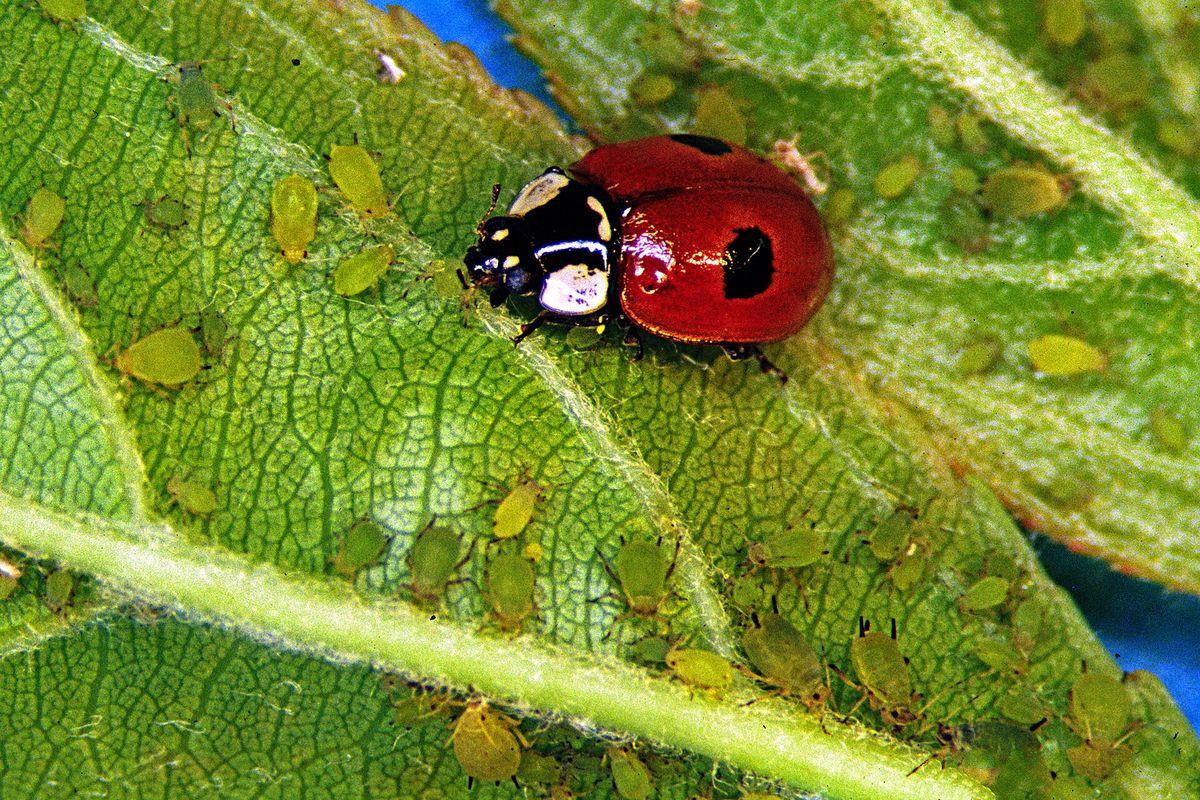
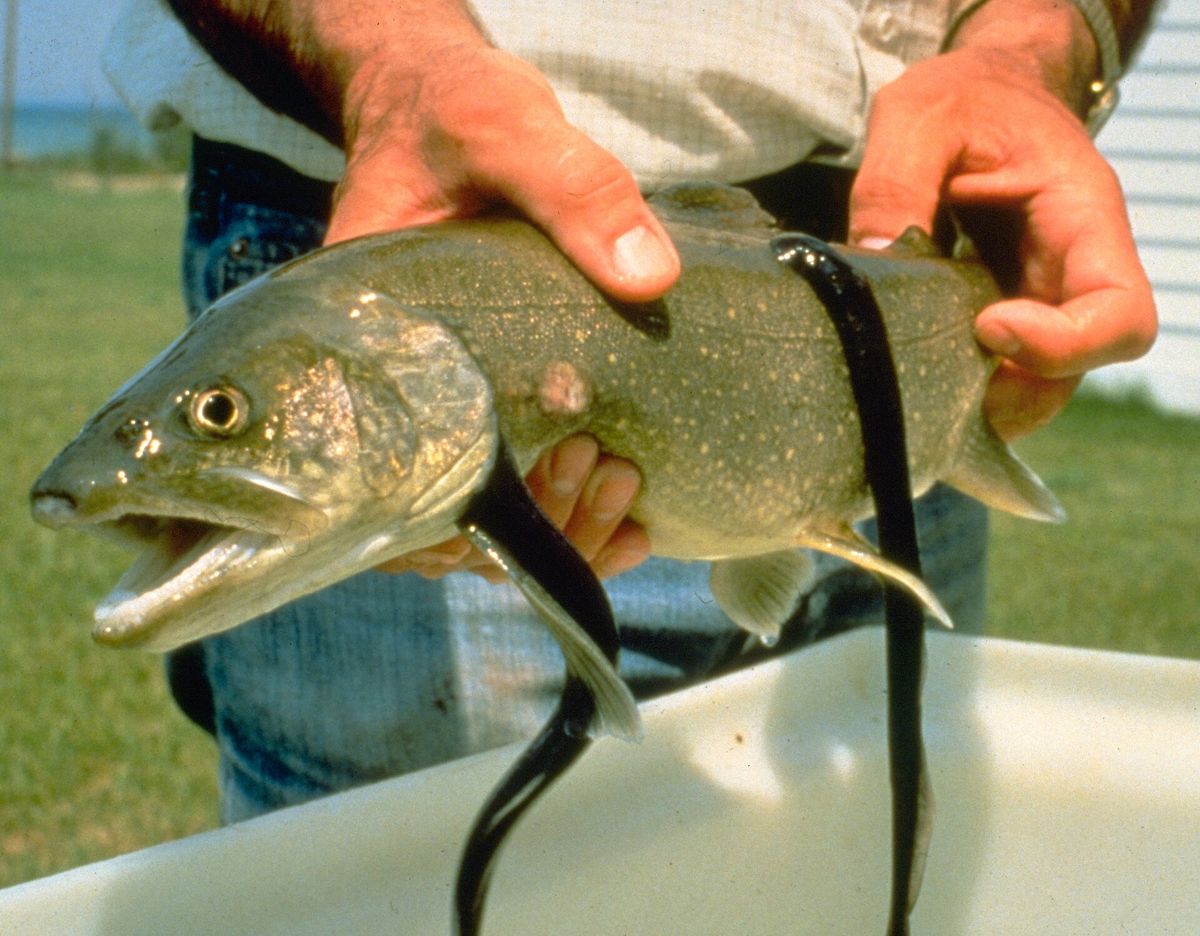
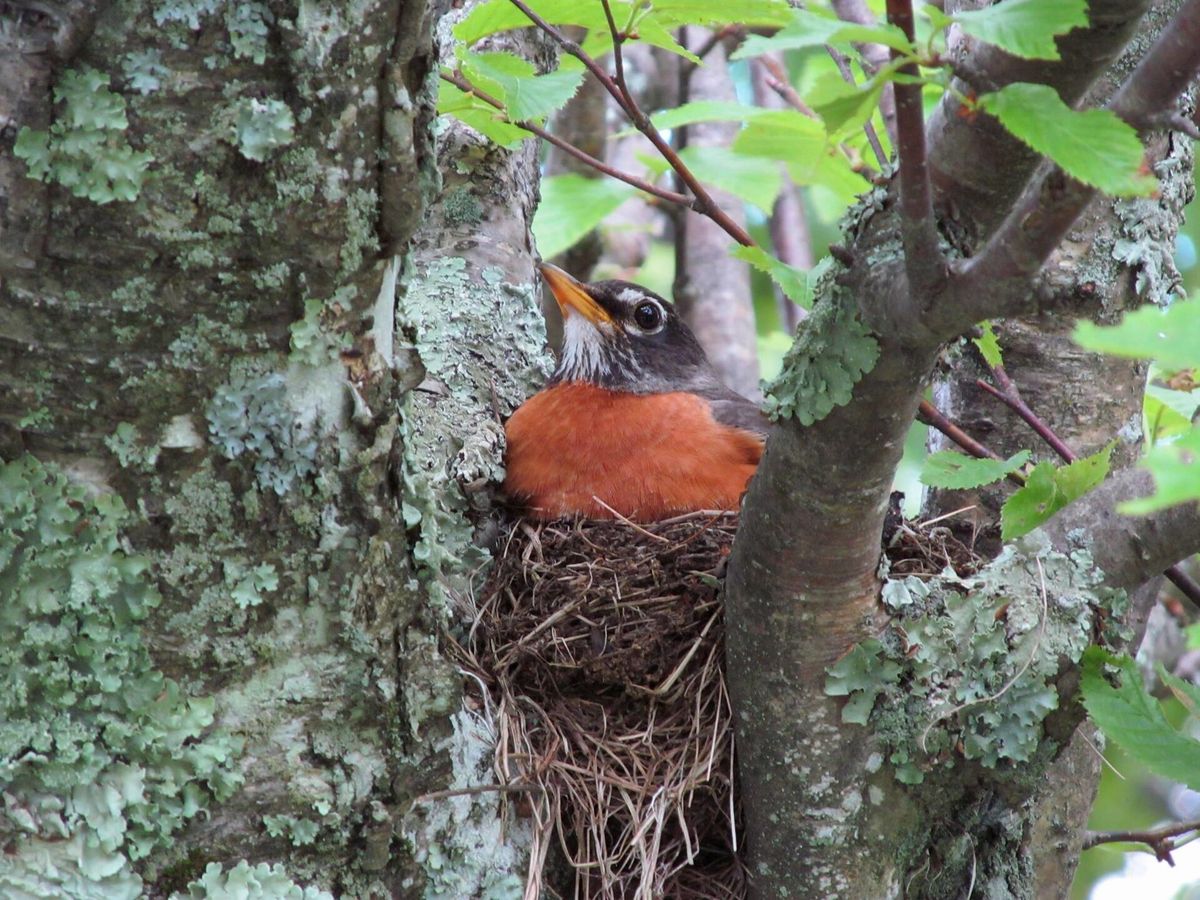
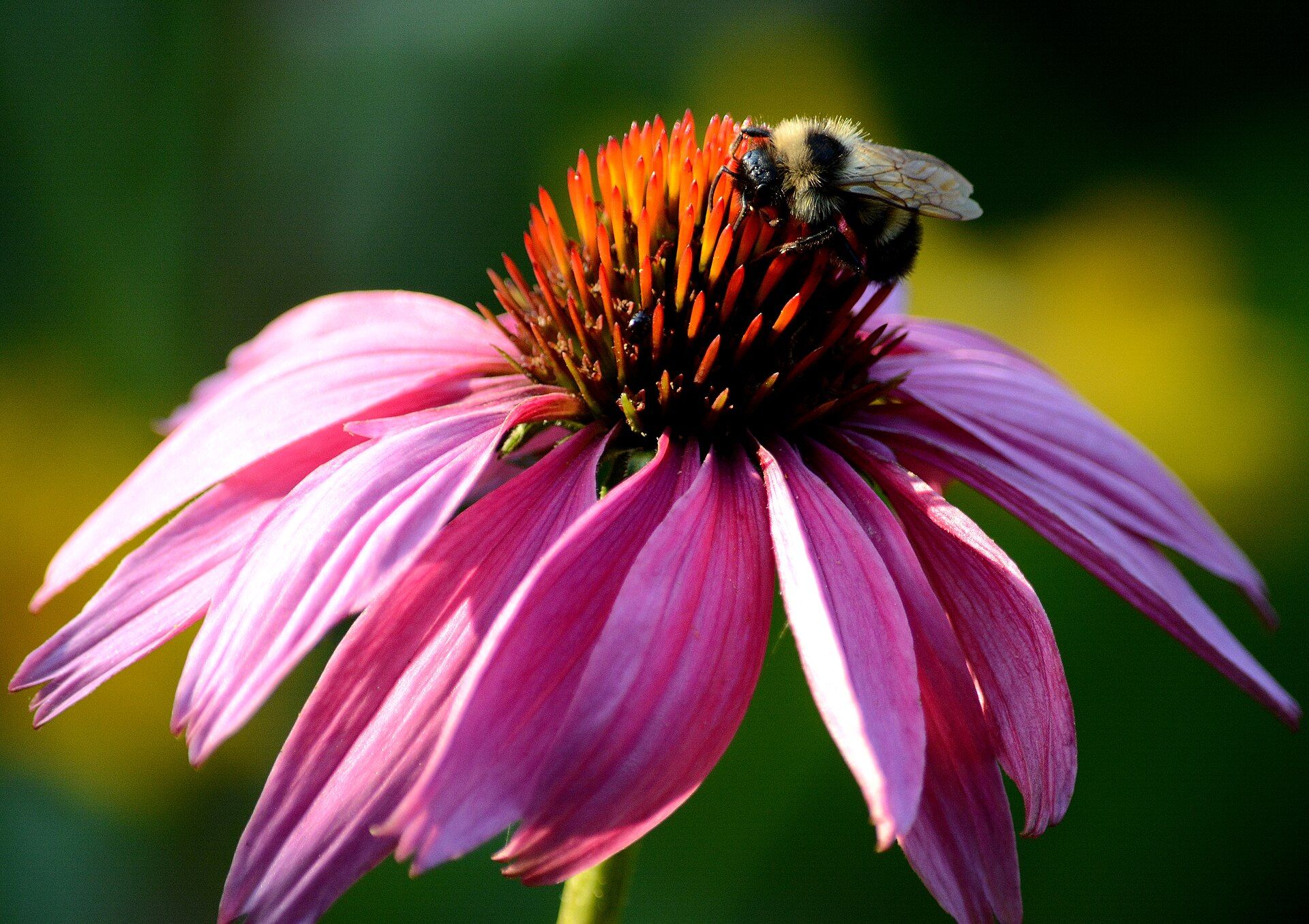
The sign code
+ does better with the other one
− does worse with the other one
0 no change
Each species in a pair gets its own sign.
Who is helped? Who is hurt? How could you find out?
Photos: Whitney Cranshaw, Colorado State University, CC BY 3.0 US · Great Lakes Fishery Commission · Shenandoah National Park
BEFORE YOU START
Get set up
1
Open mrsajdak.com/interactions on your device.
2
Write your name, the date and your period on the worksheet.
3
Find the tabs at the top of the lab. The table shows which tab goes with each part.
4
Start on Tab 1. Do not skip ahead.
| Tab in the lab | Worksheet | Questions |
|---|---|---|
| 1. Take one away | Parts 1 and 2 | 1 to 8 |
| 2. Mystery pairs | Part 3 | 9 to 11 |
| 3. Sharing a tree | Part 4 | 12 to 14 |
| 1. Take one away | Wrap it up | 15 and 16 |
Screenshot: mrsajdak.com/interactions
TAB 1 · QUESTIONS 1 TO 4
Part 1. Take one away
Scientists compare two places. One has both species. One is missing a species.
You will do the same thing in a model, with five pairs.
Photo: Todd Harless, U.S. Fish and Wildlife Service
PART 1 · TAB 1
Three runs for every pair
1
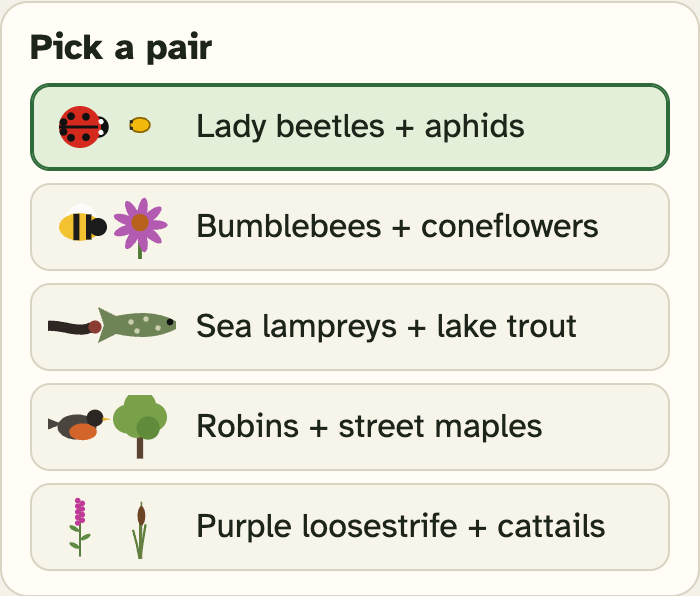
In Pick a pair, pick Lady beetles + aphids.
2
Both species are checked. Press Skip to the end.
3
Uncheck one species. That takes it away. Press Skip to the end again.
4
Check it again. Uncheck the other one. Press Skip to the end.
5
Do the same three runs for all five pairs.
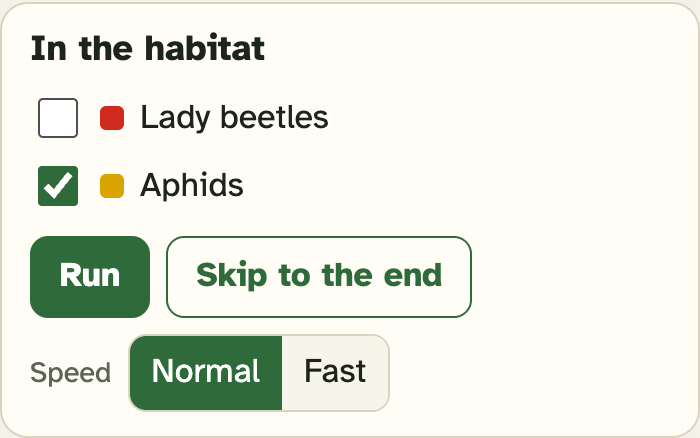
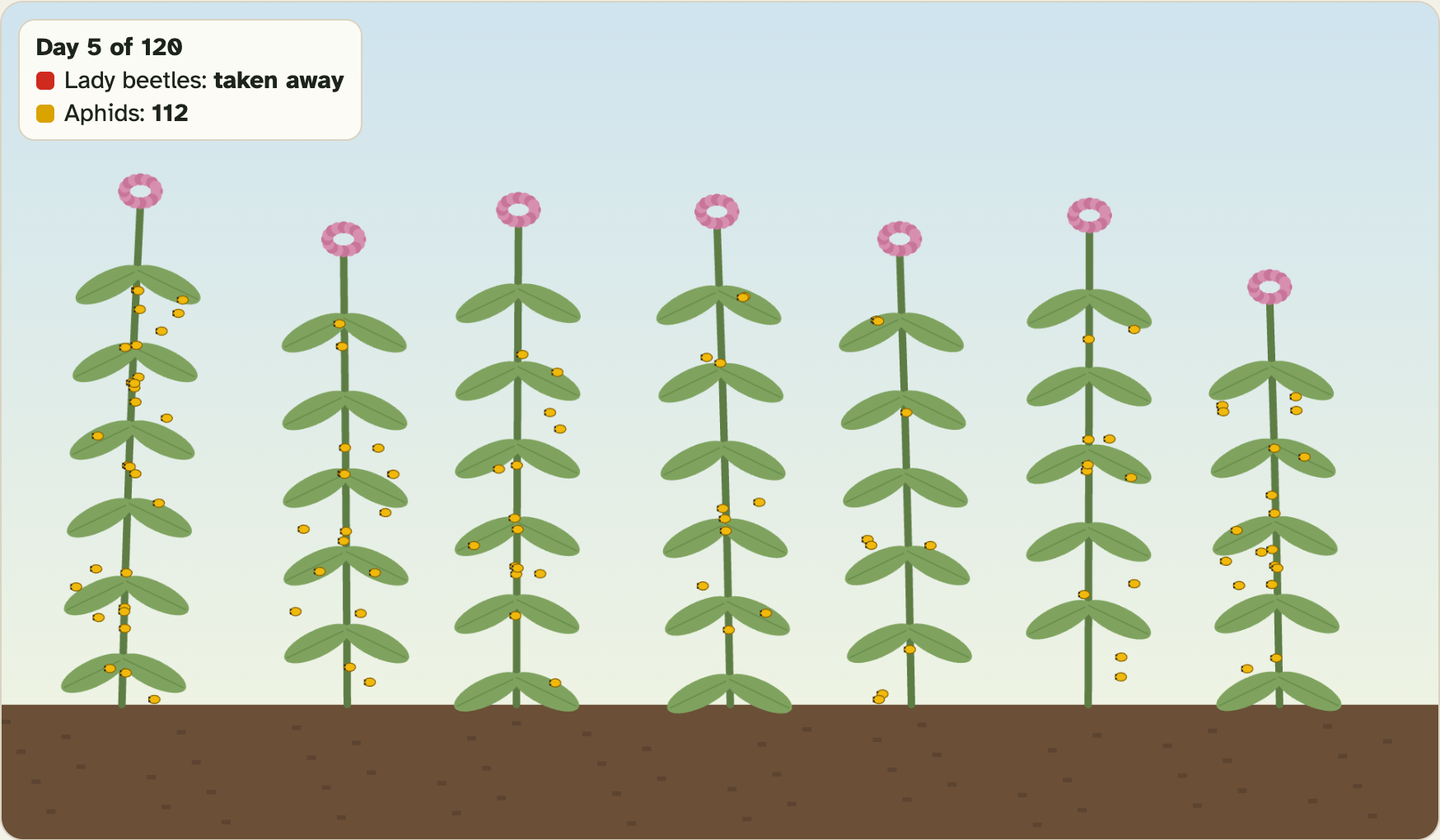
Run plays it slowly so you can watch. Skip to the end jumps to the last day or year.
The box in the corner of the picture shows the counts. A species you unchecked says taken away.
Screenshots: mrsajdak.com/interactions, Tab 1
PART 1 · QUESTION 1
Fill in the table
1
Find the Your runs box. It gets one row for each run.
2
Alone is the number in the row that ends in only.
3
With the other is the number in the row Both together.
4
Compare the two numbers. More with the other is +. Fewer is −. The same is 0.
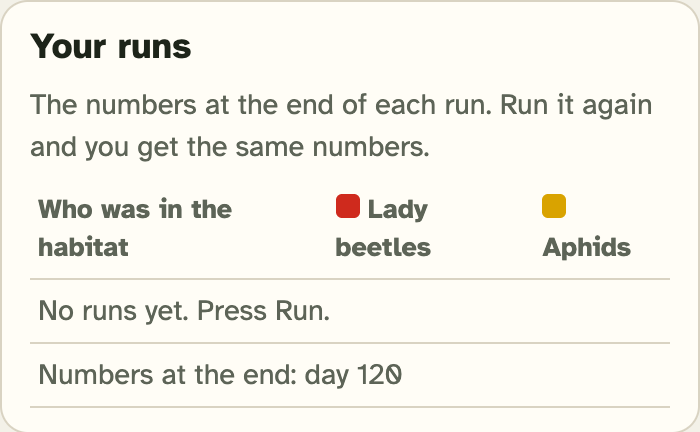
The numbers stay when you switch pairs. They are gone if you reload the page.
Example
A species ends at 12 when it is alone.
It ends at 30 with the other one.
12 alone, 30 together
It does better with the other. Its sign is +.
These are not your numbers. Use your own.
Screenshot: mrsajdak.com/interactions, Tab 1
PART 1 · QUESTION 1
Name the interaction
1
Find the Your call box.
2
Press +, − or 0 for each species.
3
Pick a name from the list.
4
Press Check. Fix it if the lab says to look again.
5
Write the name in the last column of your table.
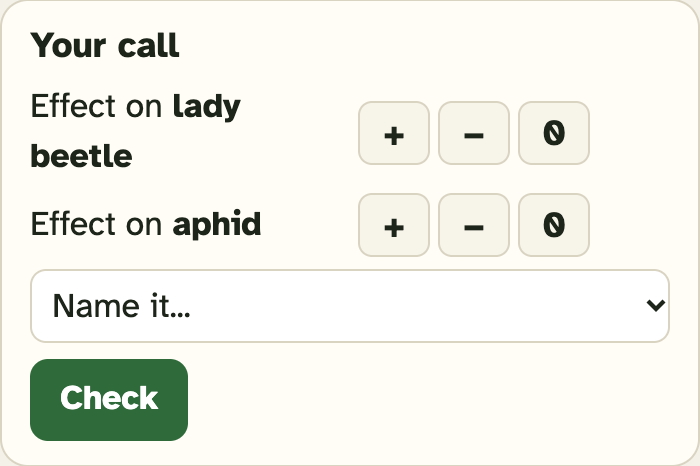
Check works only after all three runs for that pair.
| Name | Signs |
|---|---|
| Mutualism | + + |
| Commensalism | + 0 |
| Predation | + − |
| Parasitism | + − |
| Competition | − − |
These names are on your worksheet too.
Screenshot: mrsajdak.com/interactions, Tab 1
PART 1 · QUESTIONS 2 TO 4
Explain what you saw
QUESTION 2
0
No change
Find the street maples in your table. Compare alone and with robins.
What does a 0 tell you about what robins do to the maples?
QUESTION 3
+ −
Same signs, two names
Use Run, not Skip. Watch the habitat. Read the words under the picture.
What does a lady beetle do to an aphid? What does a lamprey do to a trout?
QUESTION 4
− −
Who was hurt more?
Loosestrife and cattails both did worse together.
For each plant, subtract: alone minus with the other. Use the numbers.
TAB 1 · QUESTIONS 5 TO 8
Part 2. Boom and crash
Stay on Tab 1. Pick Lady beetles + aphids. Check both species.
This time, do not skip. Watch the numbers climb and fall.
Photo: Malcolm Manners, CC BY 2.0
PART 2 · QUESTION 5
Find the highest counts
1
Press Run. Watch the graph called Population over time.
2
The box in the corner of the picture shows the day and both counts.
3
Press Pause when a line is near its top. Write the count and the day.
4
Press Keep going. Do the same for the other species.
5
Missed it? Press Run again.
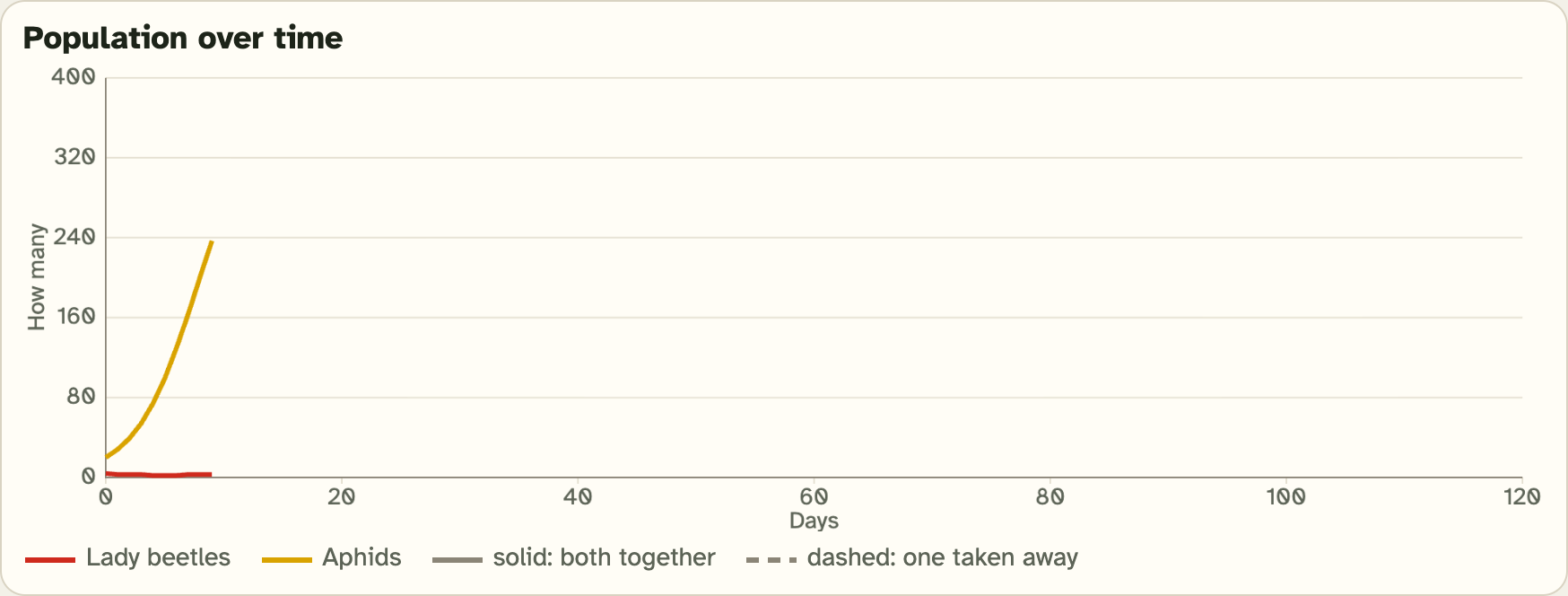
Example
90 on day 12
A line tops out at 90 when the box says Day 12. Not your numbers.
The yellow line is aphids. The red line is lady beetles. Solid lines are both together.
Screenshot: mrsajdak.com/interactions, Tab 1
PART 2 · QUESTIONS 6 AND 7
Why the lines do that
QUESTION 6
Which peaked first?
Look at your two days from Question 5.
Lady beetles eat aphids. What has to happen before there can be more lady beetles?
QUESTION 7
Carrying capacity
In Your runs, find the row Aphids only. Write that number. It is the carrying capacity.
On the graph, the dashed yellow line is the aphids alone. The solid yellow line is the aphids with lady beetles. Which one stays lower?
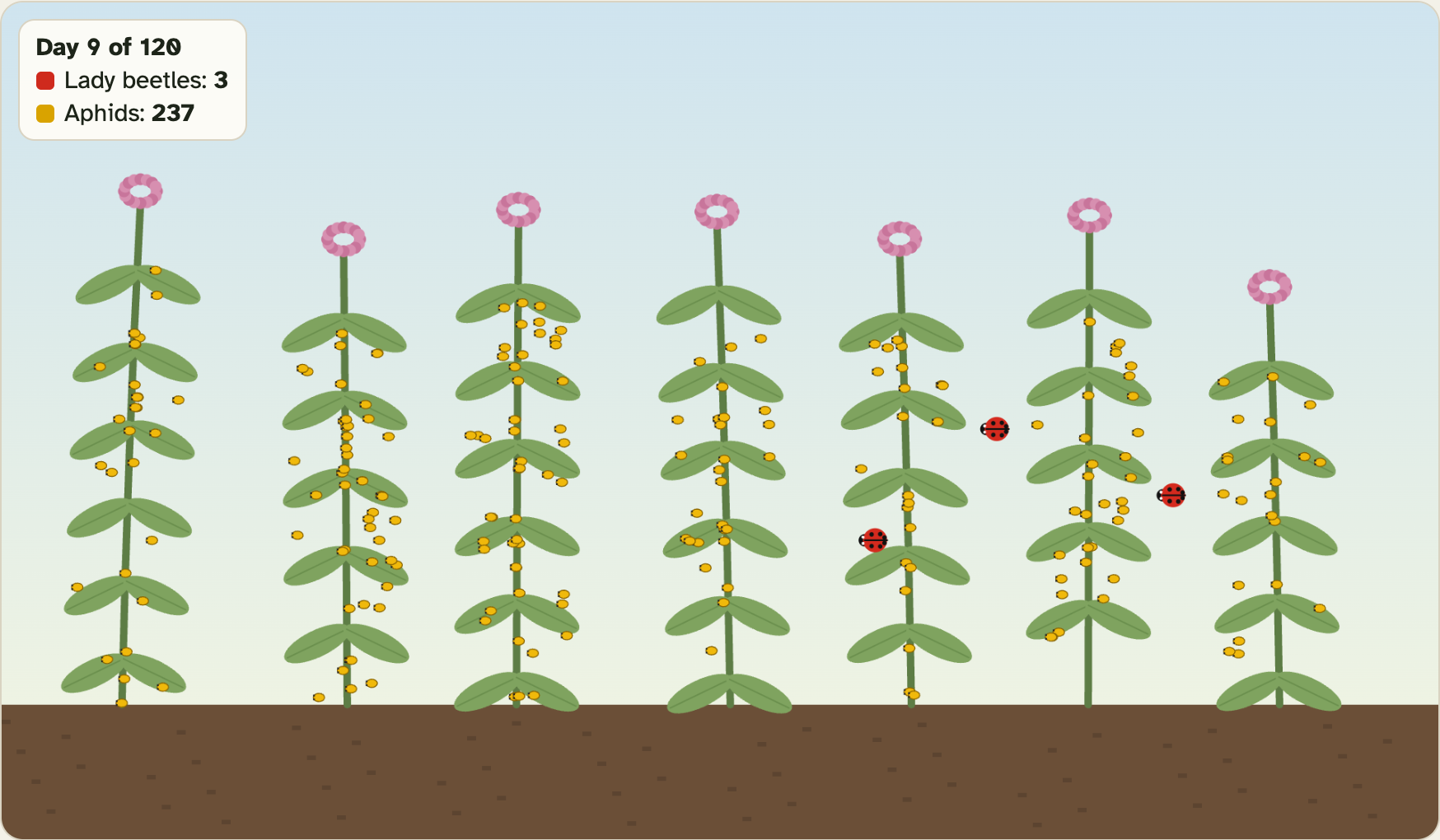
Each dot on a stem is an aphid. A red ring shows a lady beetle eating one.
Dashed lines on the graph are your runs with one species taken away.
Screenshot: mrsajdak.com/interactions, Tab 1
PART 2 · QUESTION 8
What did the lampreys cost?
1
Pick Sea lampreys + lake trout. Your three runs are still in Your runs.
2
Write the trout number from Lake trout only. Write the trout number from Both together.
3
Subtract. That is how many trout were lost.
4
Divide by the alone number. Multiply by 100. Show your work.
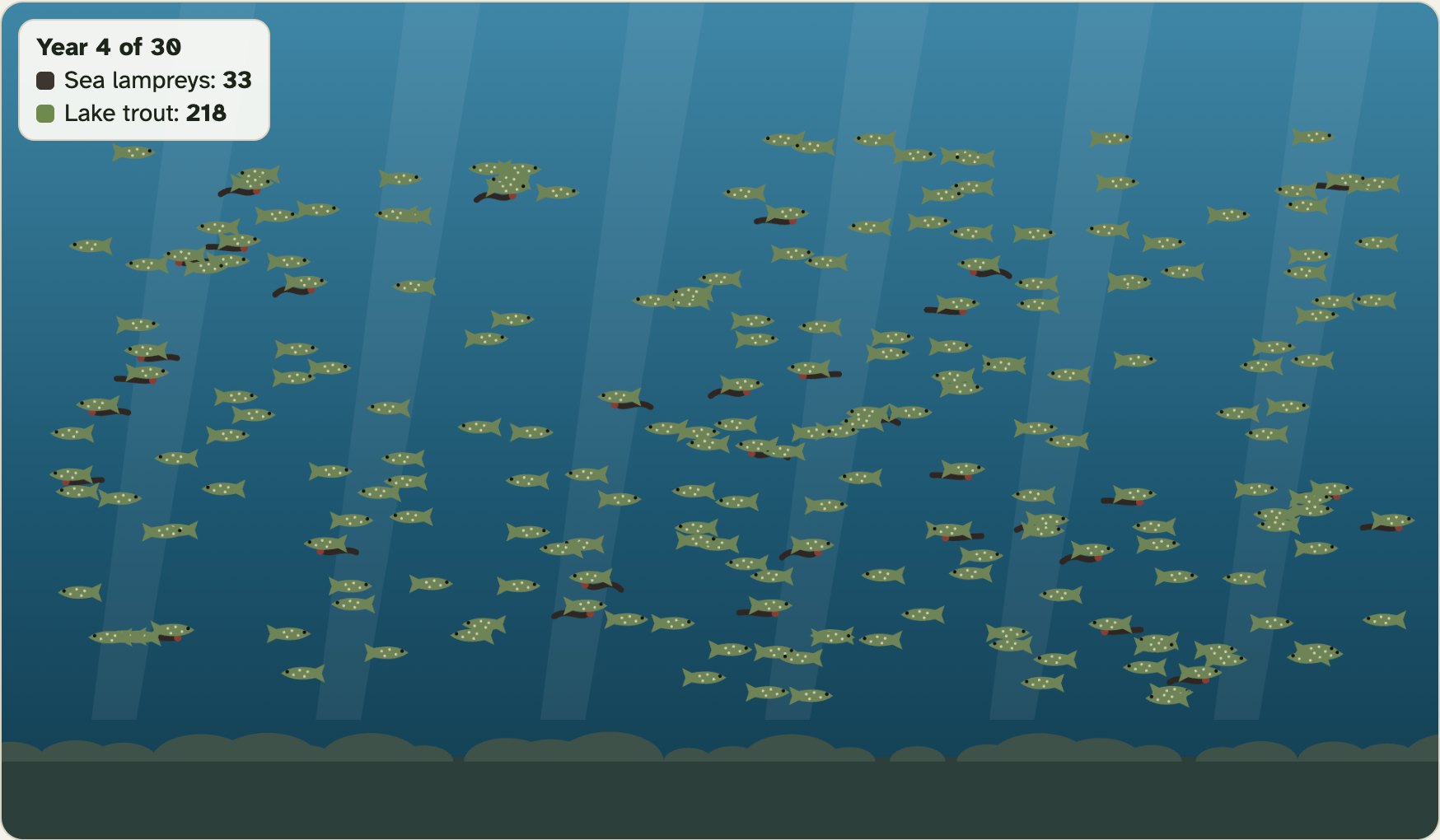
A lamprey rides on a trout. A trout that dies turns pale and floats up.
Example
Alone, a species ends at 200.
With the other one, it ends at 150.
200 − 150 = 50
50 ÷ 200 = 0.25
The other species cost it 25%.
These are not your numbers. Use your own.
Screenshot: mrsajdak.com/interactions, Tab 1
TAB 2 · QUESTIONS 9 TO 11
Part 3. Mystery pairs
Scientists count first. Then they decide.
You get two real species with their names hidden. The numbers are your only evidence.
Photo: Ashley Spratt, U.S. Fish and Wildlife Service
PART 3 · QUESTION 9
Solve a mystery pair
1
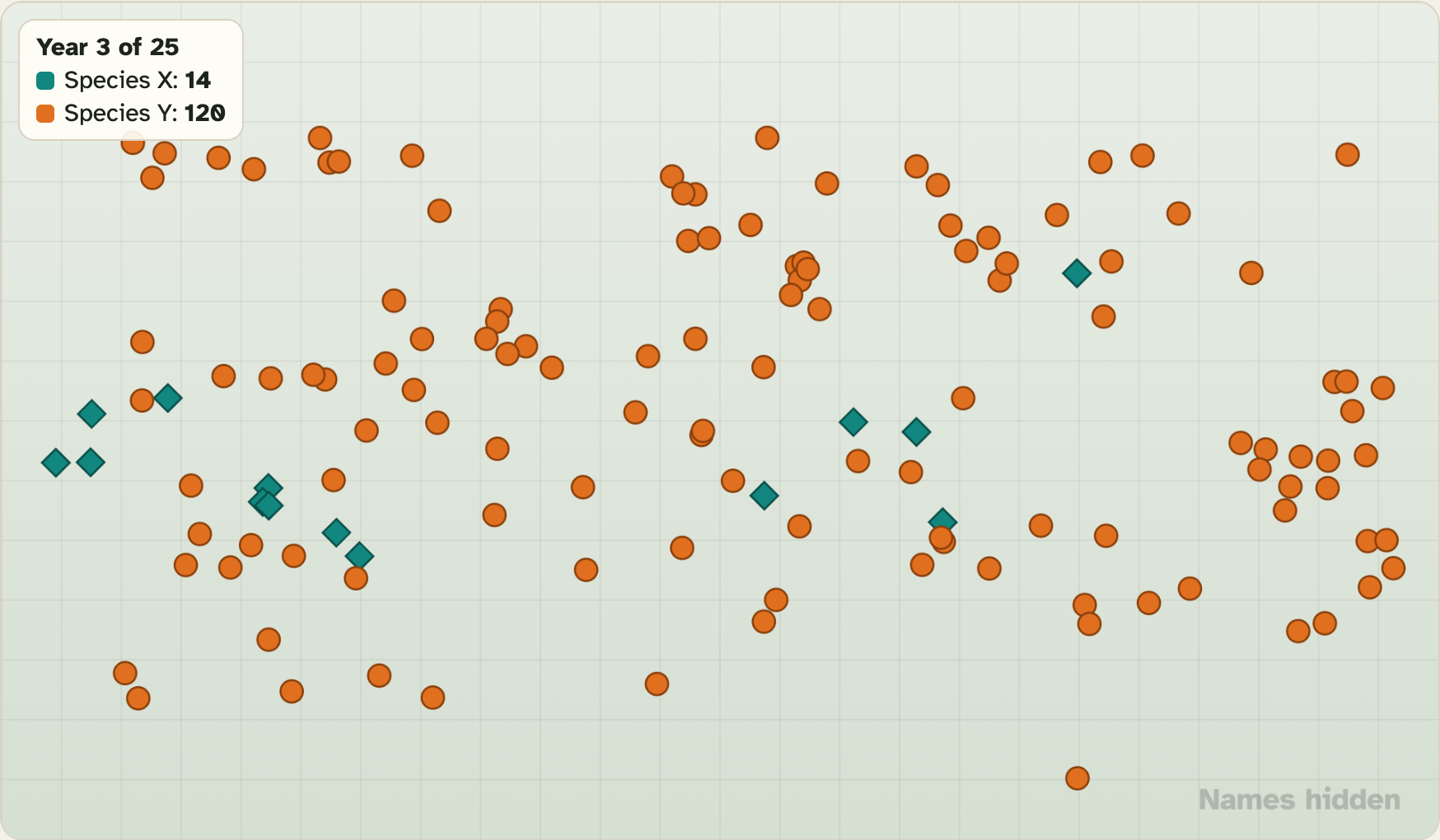
Open Tab 2. Species X is the teal diamond. Species Y is the orange circle.
2
Do three runs: both together, X alone, Y alone.
3
Copy the four numbers from Your runs. Write the signs.
4
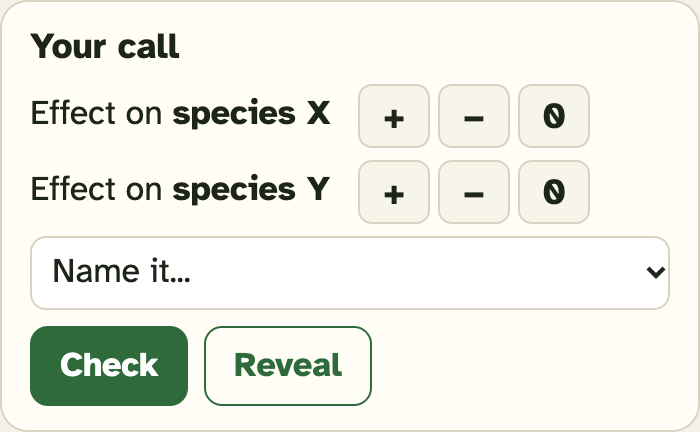
Make your call in Your call. Press Check.
5
Then press Reveal. Write the real names.
6
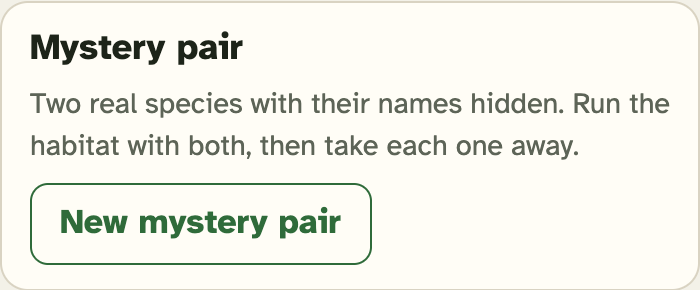
Press New mystery pair. Do it again for trial 2.
X alone means Y is unchecked.
The lab picks your pair at random. Your neighbor may get a different one.
Screenshots: mrsajdak.com/interactions, Tab 2
PART 3 · QUESTION 10
Claim, evidence, reasoning
Claim
Pick one trial. Name the interaction. Use one of the five names.
Evidence
Give four numbers from your table: X alone, X with Y, Y alone, Y with X.
Reasoning
Tie each change to a sign. More with the other is +. Fewer is −. The same is 0. Then say which name has those signs.
Example
X ends at 10 alone and 50 with Y. That is a +.
Y ends at 80 alone and 80 with X. That is a 0.
+ and 0
Those are the signs for commensalism.
These are not your numbers. Use your own.
PART 3 · QUESTION 11
Same signs, different story
QUESTION 11
Can the numbers tell them apart?
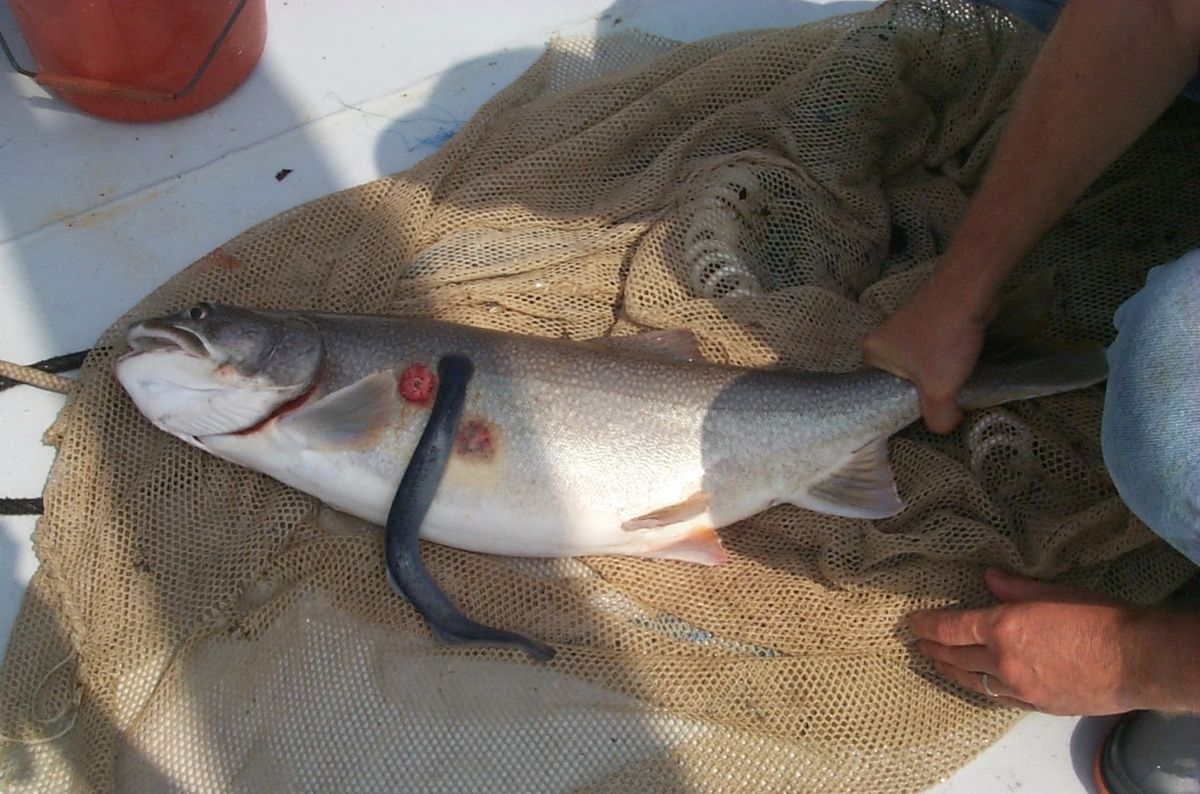
Predation has the signs + and −. So does parasitism.
Think back to Question 3. How did you tell the lady beetle from the lamprey?
What else would a scientist need to see?
After you press Reveal, read the story about your pair. It tells what the two species really do.
Photo: U.S. Fish and Wildlife Service
TAB 3 · QUESTIONS 12 TO 14
Part 4. Sharing a tree
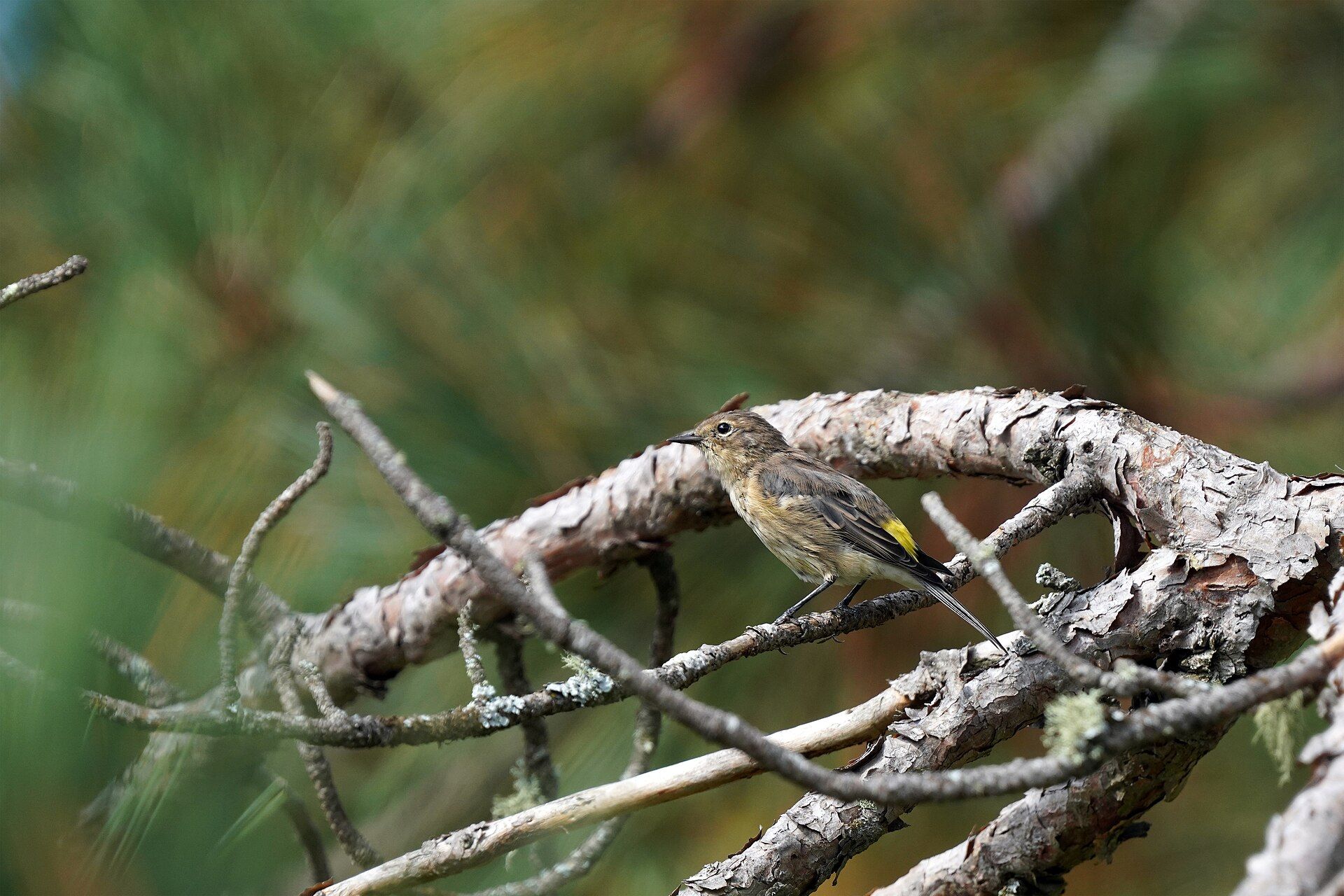
Three kinds of warbler eat insects in the same spruce trees.
Can all three live there? It depends on how they feed.
Photo: Courtney Celley, U.S. Fish and Wildlife Service
PART 4 · QUESTION 12
Two ways to feed
1
Open Tab 3. Keep all three warblers checked.
2
In How do they feed?, pick Anywhere in the tree.
3
Press Skip to the end. The run ends at year 50.
4
Pick Each in its own part. Press Skip to the end again.
5
Copy both rows from Your runs.
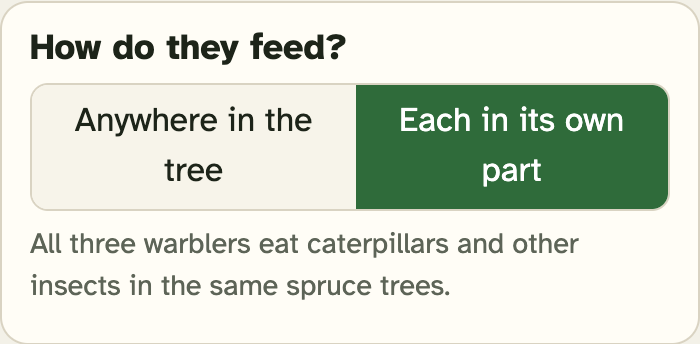
Your runs lists both ways. Look for Anywhere and Own part.
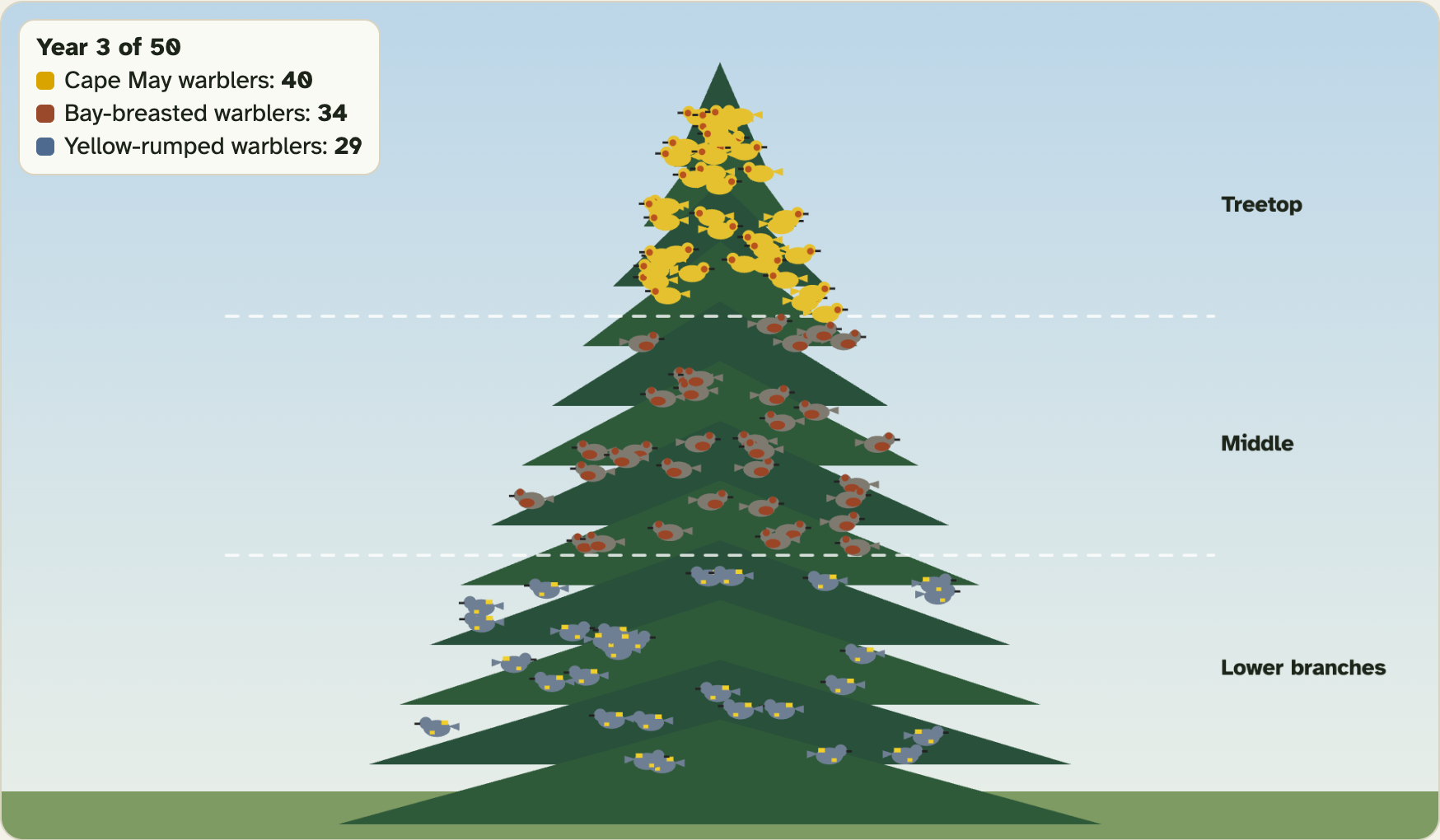
The dashed lines mark the three parts: treetop, middle and lower branches.
Screenshots: mrsajdak.com/interactions, Tab 3
PART 4 · QUESTIONS 13 AND 14
Why sharing works
QUESTION 13
Same food
Feeding anywhere
Look at your first row. What happened to two of the warblers?
Why? Use the word competition.
QUESTION 14
Own part
Resource partitioning
Resource partitioning means splitting up food or space.
Look at your second row. How does it let all three live in one tree?
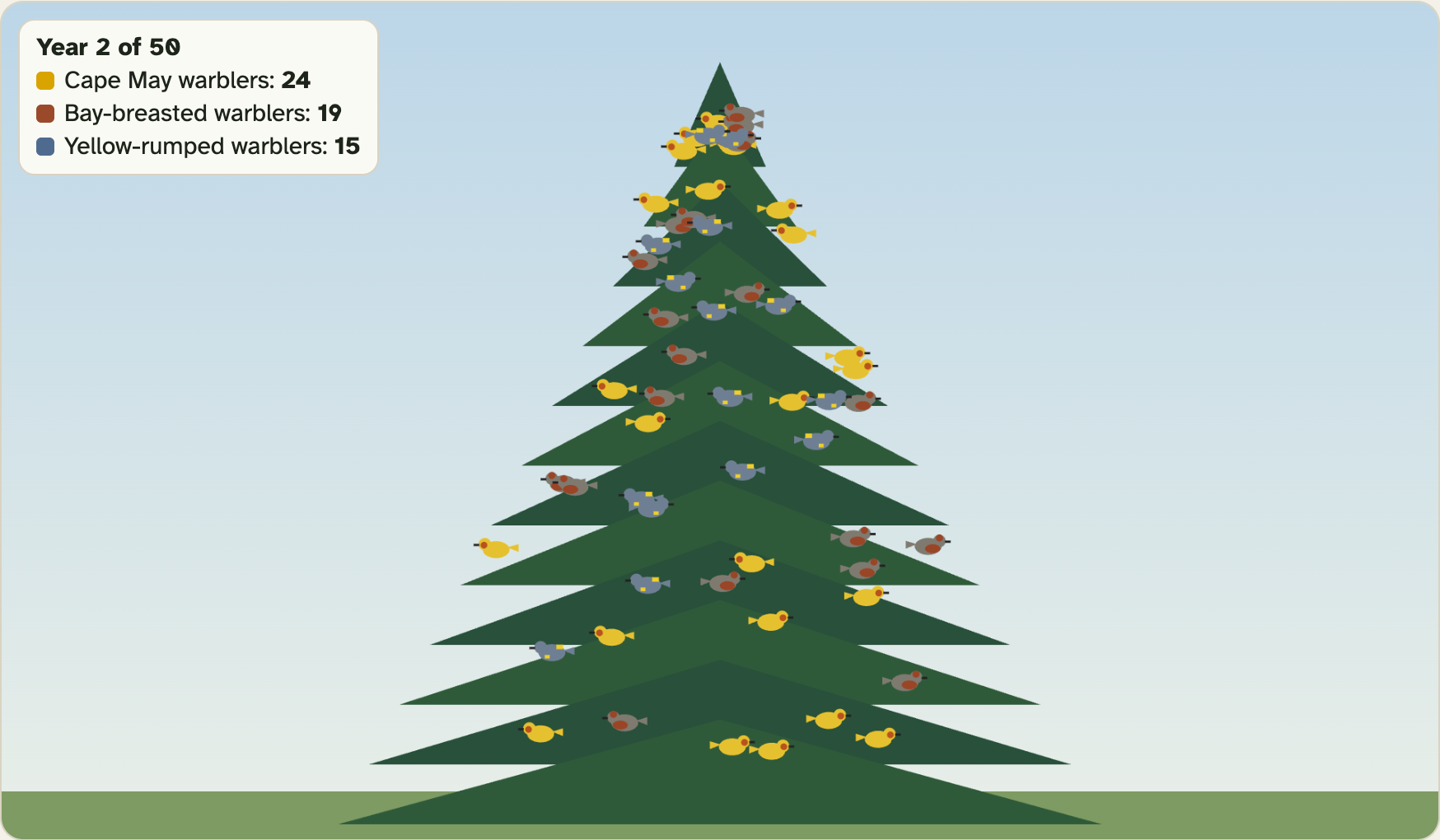
Year 2 with Anywhere in the tree. All three kinds hunt in the same places.
Screenshot: mrsajdak.com/interactions, Tab 3
WRAP IT UP · QUESTIONS 15 AND 16
Predict, test and argue
Predict
Since 1958, crews have treated streams to kill young sea lampreys. What happens to the lake trout if all the lampreys are gone? Write it first.
Test
Go to Tab 1. Pick Sea lampreys + lake trout. Uncheck Sea lampreys and run it. Were you right?
The claim
“In every interaction, one species wins and one species loses.”
Argue
Use two pairs from your Question 1 table. Find pairs where the signs are not one + and one −.
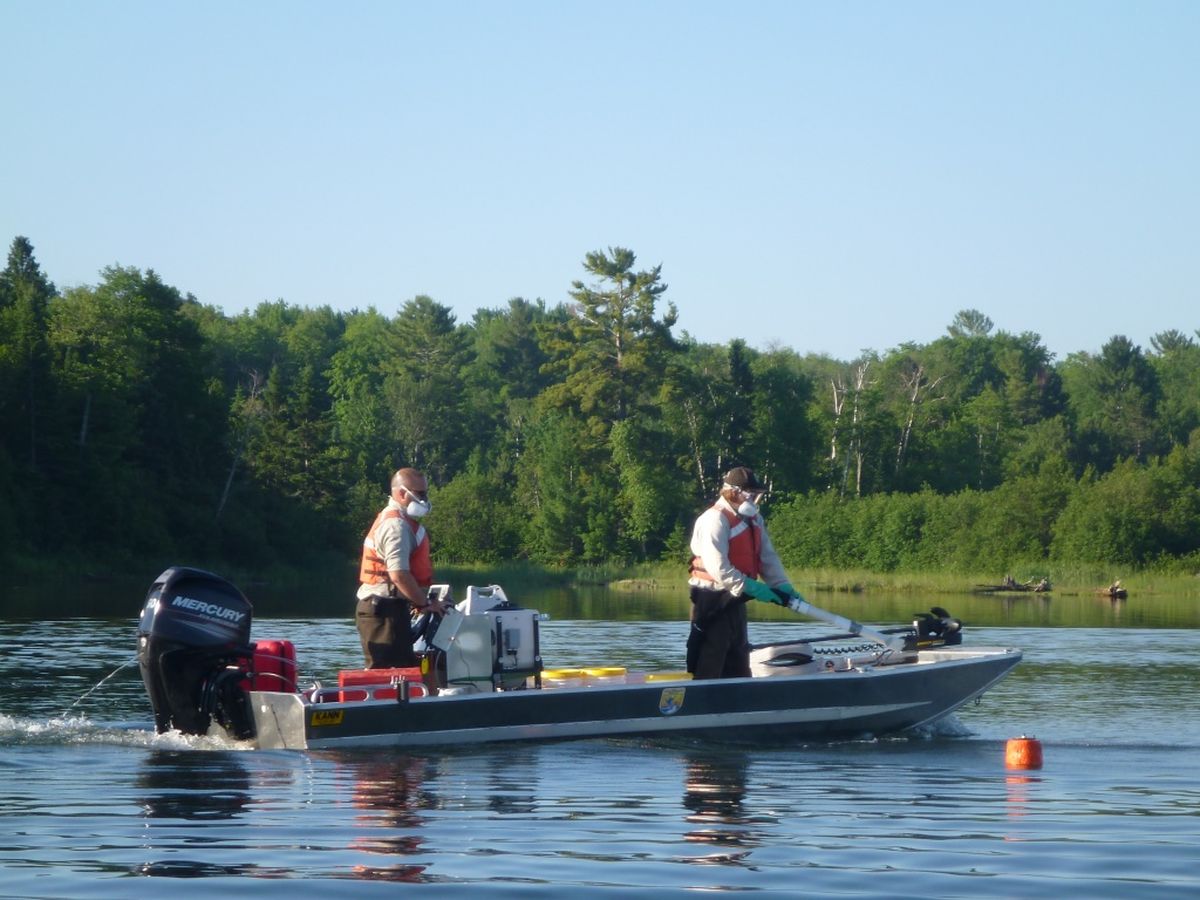
A crew treats the water to kill young sea lampreys.
Photo: U.S. Fish and Wildlife Service
LAST CHECK
Before you hand it in
Name, date and period are on top.
All three tables are full.
Question 8 shows your work.
Every claim uses numbers or signs from your own tables.
Photo: Debbie Koenigs, U.S. Fish and Wildlife Service