ANATOMY AND PHYSIOLOGY · CHAPTER 6
Hair, Nails and Glands Lab
Follow along with your worksheet, one question at a time.
mrsajdak.com/skin-appendages
Photo: Pete Bellis, CC0
BEFORE YOU START
Made the same way
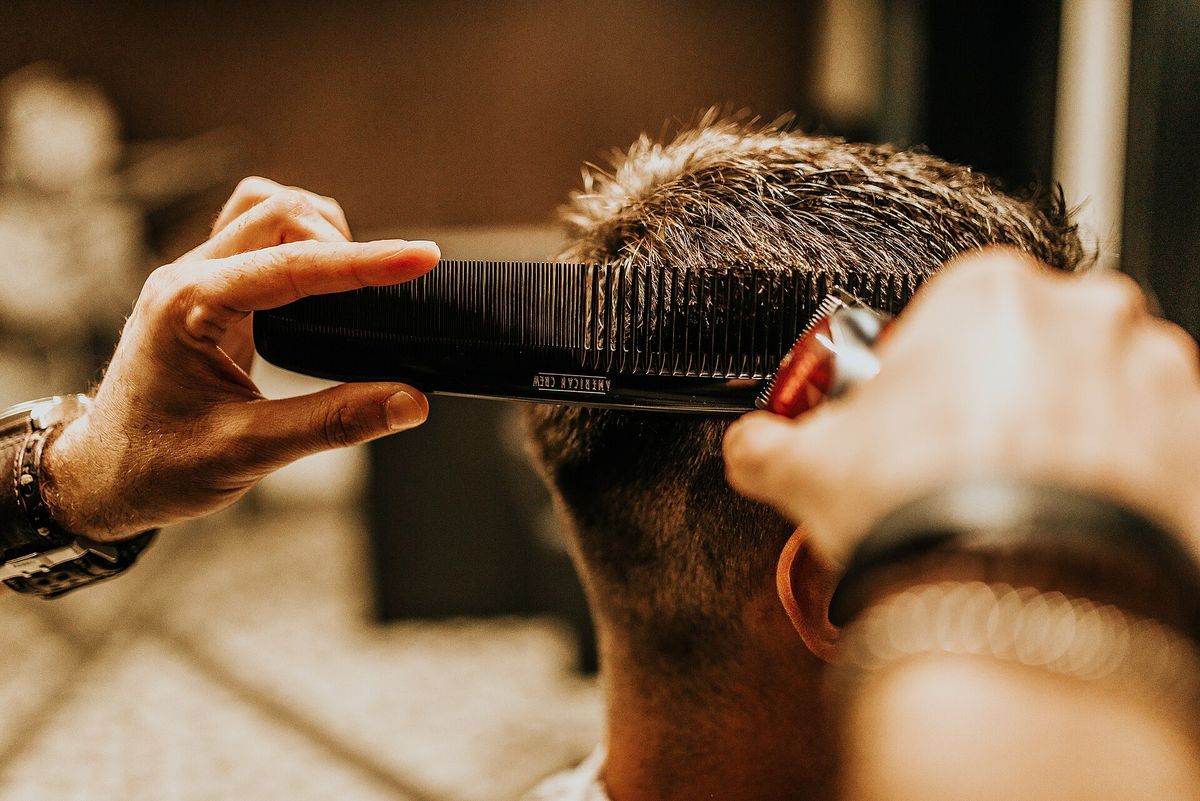
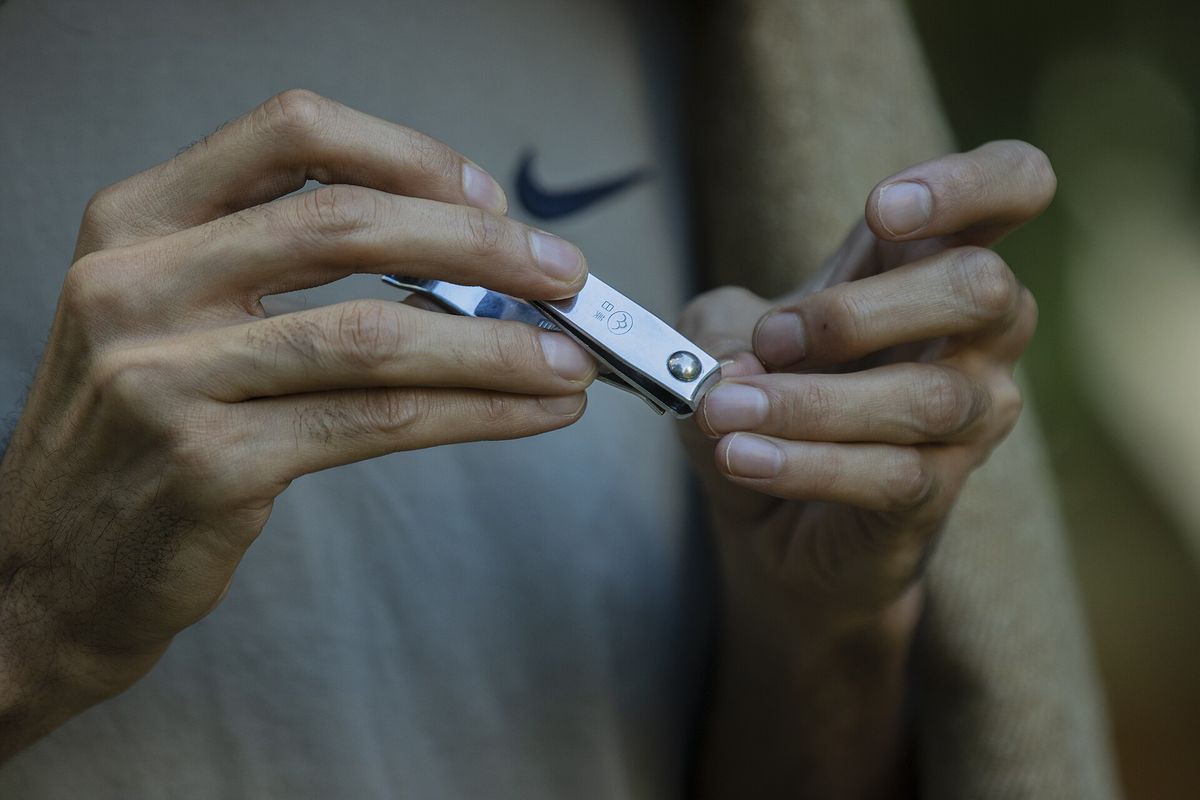
How both are made
1. Living cells divide.
2. The cells fill with keratin.
3. The cells die.
4. Newer cells push them out.
Keratin is a tough protein. It makes hair and nails hard.
If you cut a hair, does it grow back faster? How could you test that?
Photos: Nenad Stojkovic, CC BY 2.0 · Mostafameraji, CC0
BEFORE YOU START
Get set up
1
Open mrsajdak.com/skin-appendages on your device.
2
Write your name, the date and your period on the worksheet.
3
Find the five tabs at the top of the lab. Each tab goes with one part of the worksheet.
4
Day 1 is the front of the worksheet. Day 2 is the back.
5
Start on Tab 1. Do not skip ahead.

| Tab in the lab | Worksheet | Questions |
|---|---|---|
| 1. Build a hair | Part 1 | 1 to 6 |
| 2. Grow a nail | Part 2 | 7 to 9 |
| 3. Hair evidence | Part 3 | 10 to 12 |
| 4. Three glands | Part 4 | 13 to 16 |
| 5. Sweat-print test | Part 5 and Wrap it up | 17 to 20 |
Screenshot: mrsajdak.com/skin-appendages
DAY 1 · TAB 1 · QUESTIONS 1 TO 6
Part 1. Build a hair
A hair follicle is a tube in your skin. One hair grows inside it.
You will name the parts of a follicle. Then you will grow a hair and watch what it does.
Photo: EverJean, CC BY 2.0
PART 1 · QUESTION 1
Name the seven parts
1
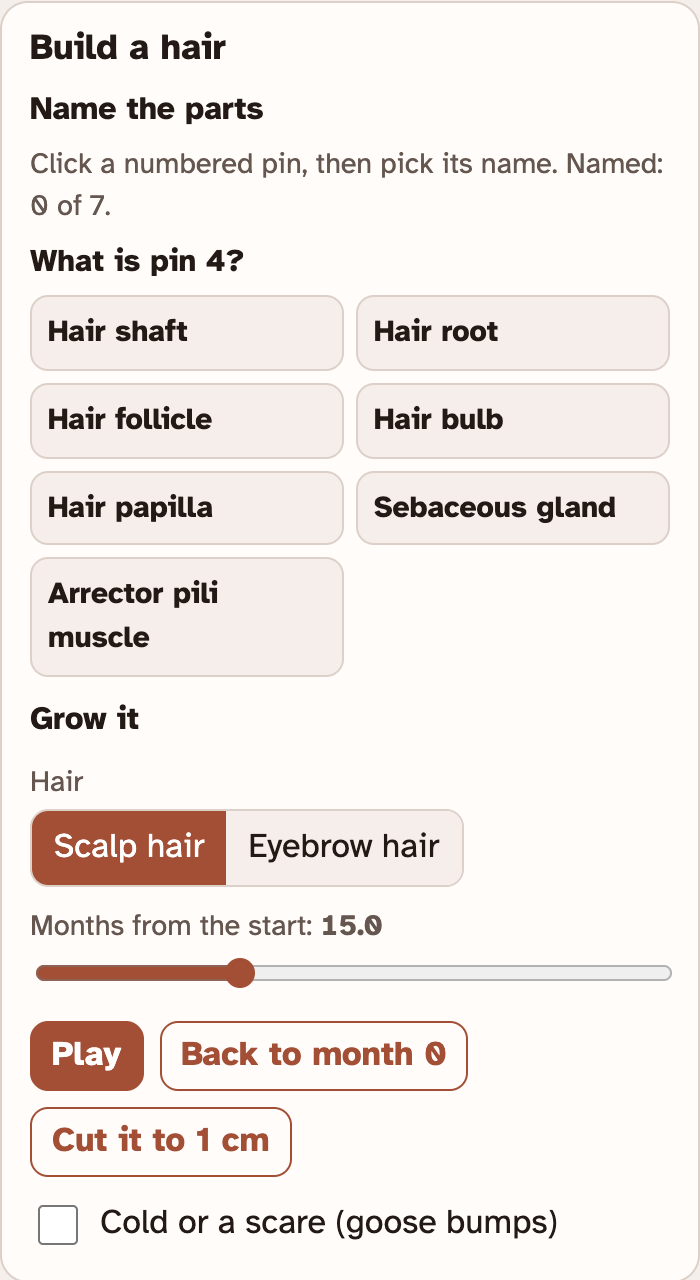
Click a numbered pin in the drawing.
2
Pick its name from the list. A wrong name gets crossed out. Try again.
3
Read what the part does. The lab tells you after you name it.
4
Do all seven pins. The box counts them for you.
5
On the worksheet, write the letter of each part’s job. Two parts share a job.
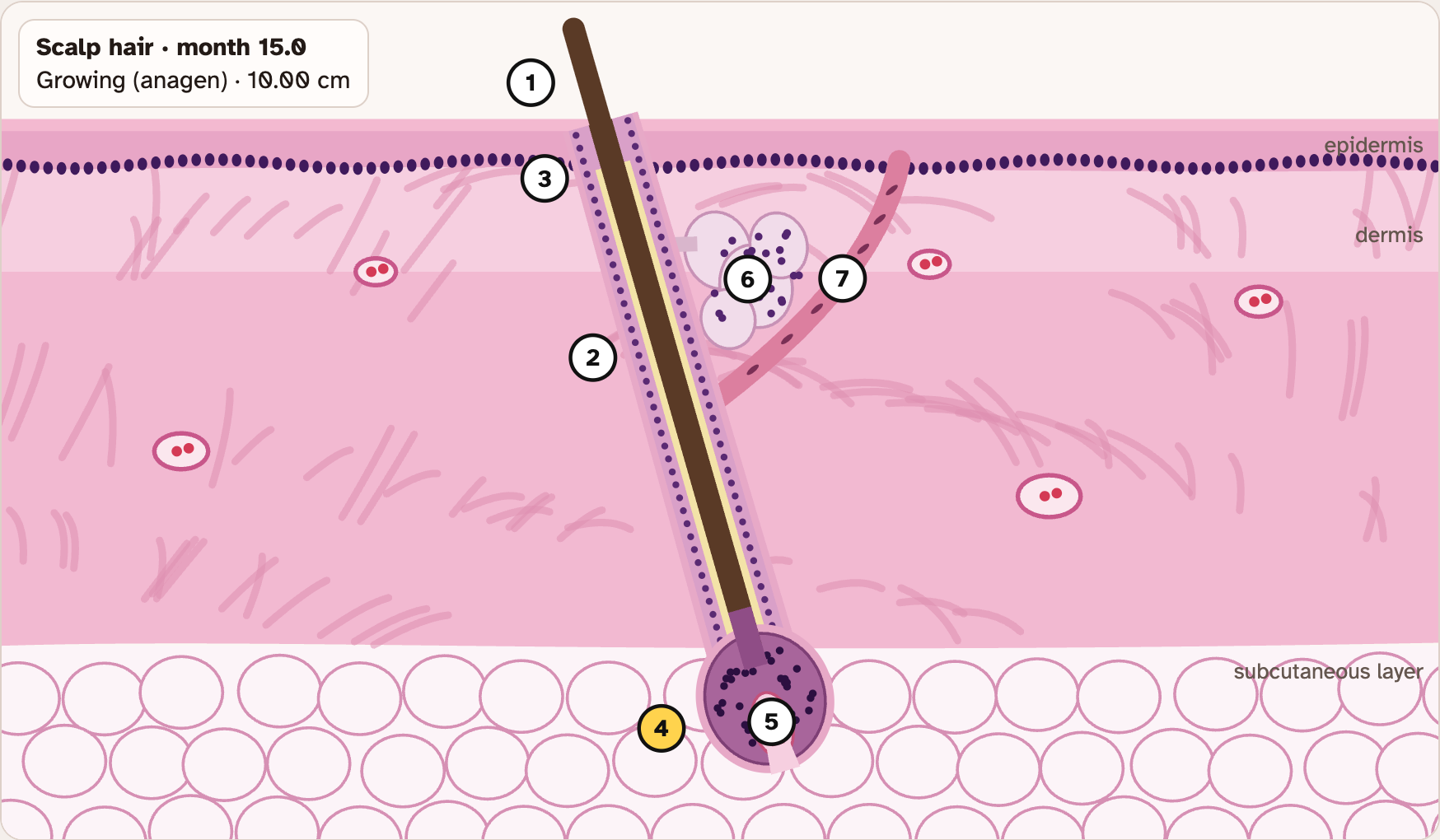
Pins 4 and 5 hide when the hair is resting. Press Back to month 0 to see them.
The pin you clicked turns yellow. A named pin turns green.
Screenshots: mrsajdak.com/skin-appendages, Tab 1
PART 1 · QUESTIONS 2 AND 3
Grow a hair and read it
1
Under Grow it, pick Scalp hair. Press Play. Watch one whole growing phase.
2
cm per month: read Grows on the Right now card.
3
Growing phase and Longest: read the graph. The growing phase is the green band.
4
Check your work. Rate × months should match the longest length.
5
Do it all again for Eyebrow hair.
6
Question 3: drag the slider to month 36.5. Read Phase.
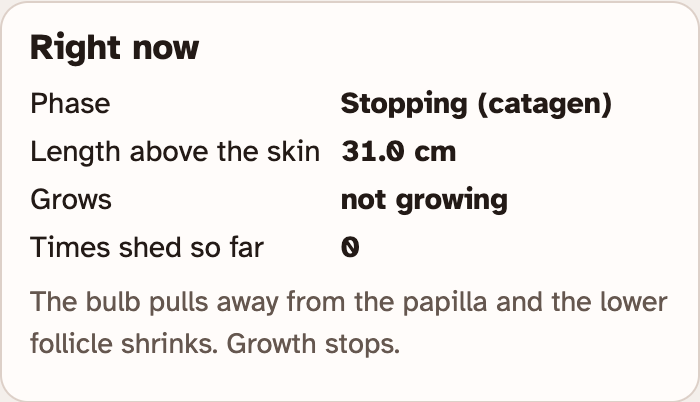
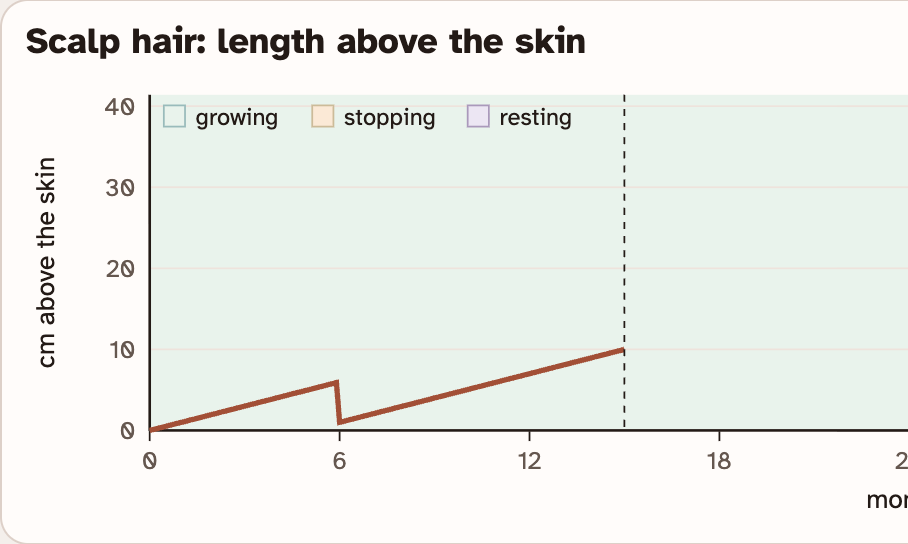
This hair was cut once. Yours will not be.
Example
A hair grows 2 cm a month.
Its growing phase lasts 5 months.
2 × 5 = 10
The longest it can get is 10 cm.
These are not your numbers. Use your own.
Screenshots: mrsajdak.com/skin-appendages, Tab 1
PART 1 · QUESTIONS 4 TO 6
Test it, then explain it
QUESTION 4
Cut
Does cutting change it?
Set the scalp hair to month 10. Press Cut it to 1 cm. Slide to month 12. Read the length.
Did it grow faster? Think about where a hair is made.
QUESTION 5
Short
Why do eyebrows stay short?
Look at your Question 2 table. Compare the two growing phases.
Use both numbers in your answer.
QUESTION 6
Brr
Cold or a scare
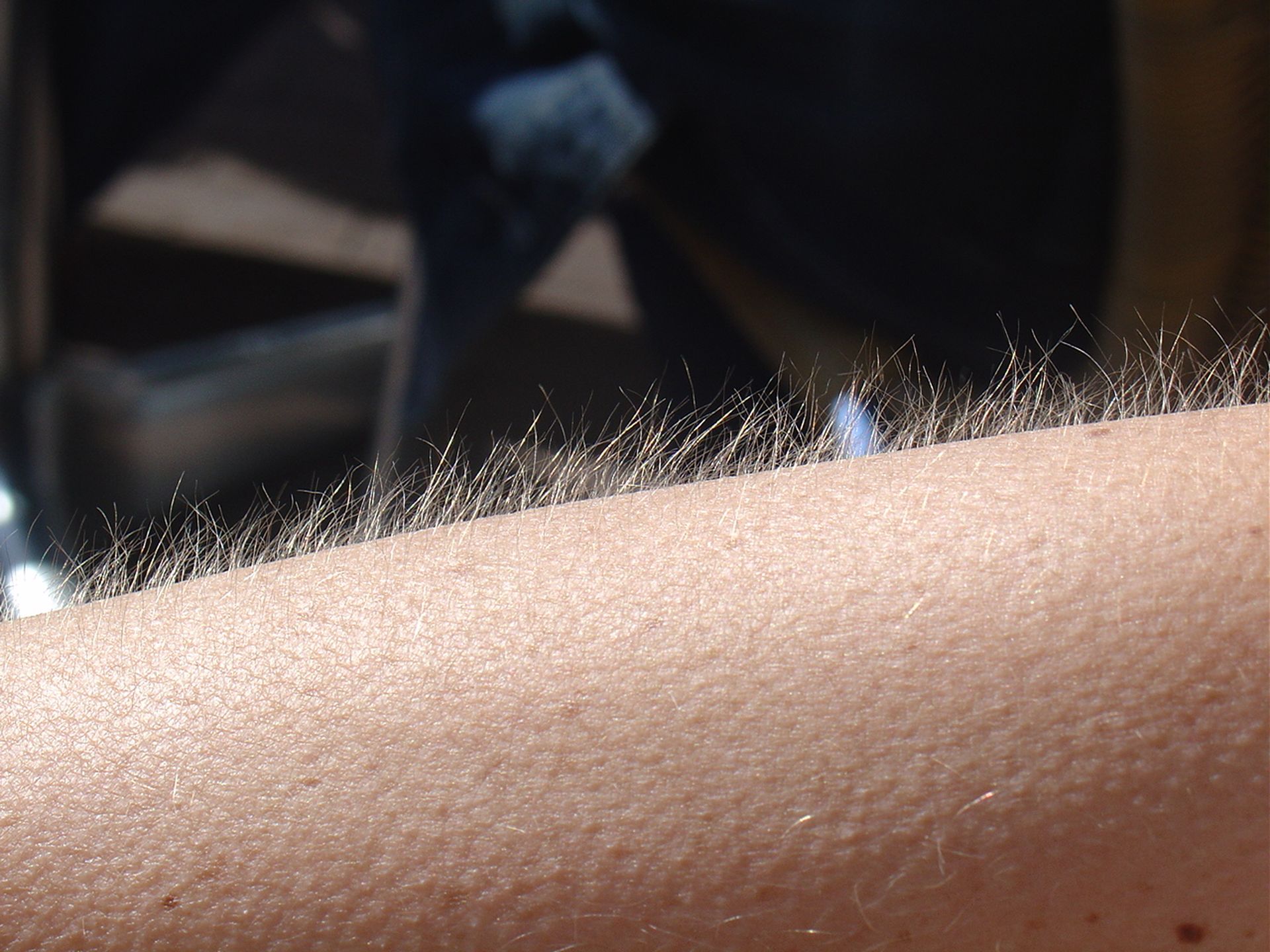
Tick Cold or a scare (goose bumps). Watch the drawing.
One part pulls tight. Which one? What does the hair do?
DAY 1 · TAB 2 · QUESTIONS 7 TO 9
Part 2. Grow a nail
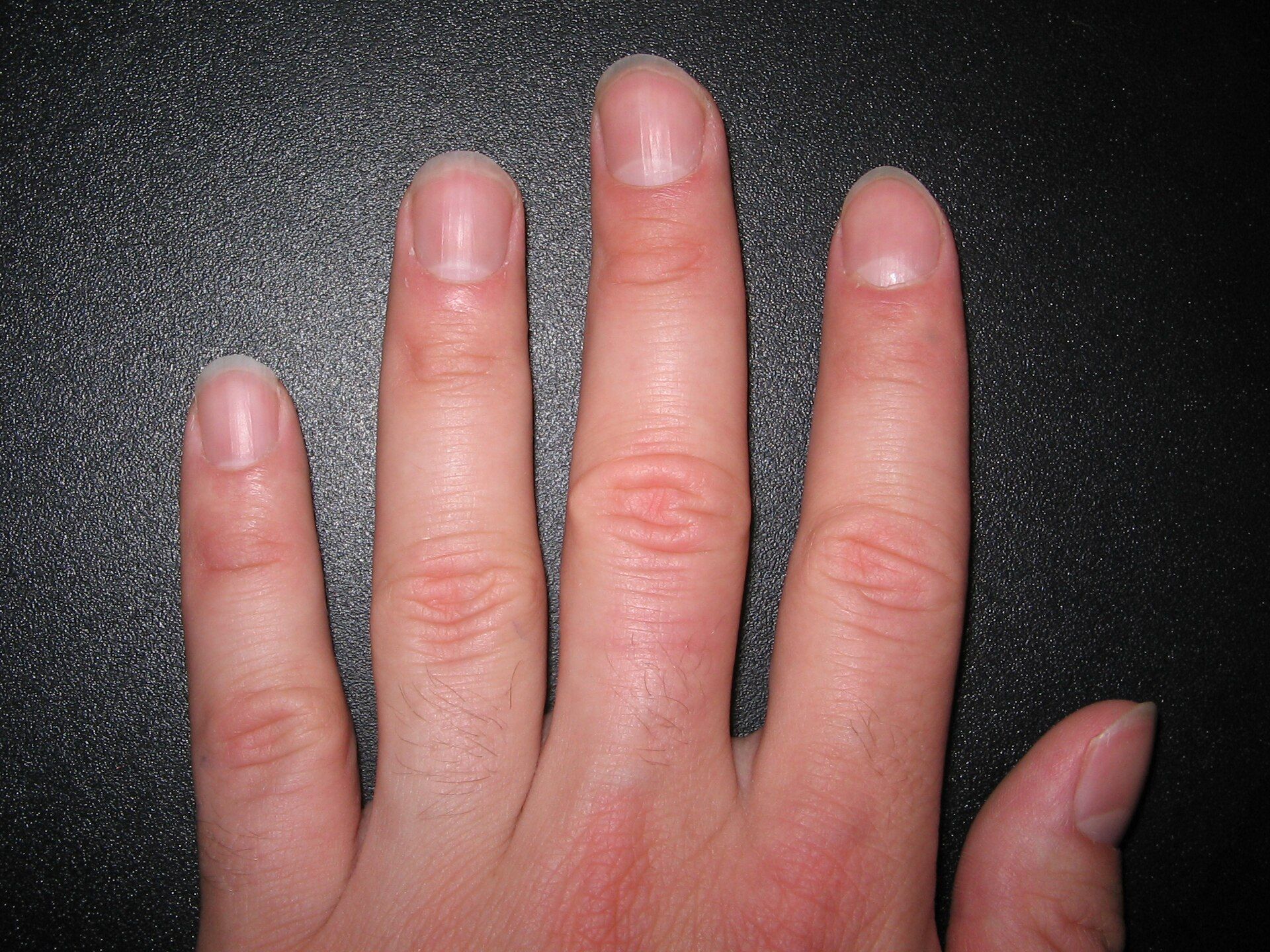
Your nails never stop growing. That is why you have to trim them.
You will mark a nail with a blue line. Then you will time how fast the line moves out.
Photo: Kommissar, public domain
PART 2 · QUESTION 7
Name the six parts
1
Click each pin. Pick its name. It works the same way as Tab 1.
2
Pins 5 and 6 are on the side view. Those parts are under the nail.
3
Read what each part is made of. The lab tells you after you name it.
4
On the worksheet, tick one box under each part. Is it living cells, dead plate, or skin?
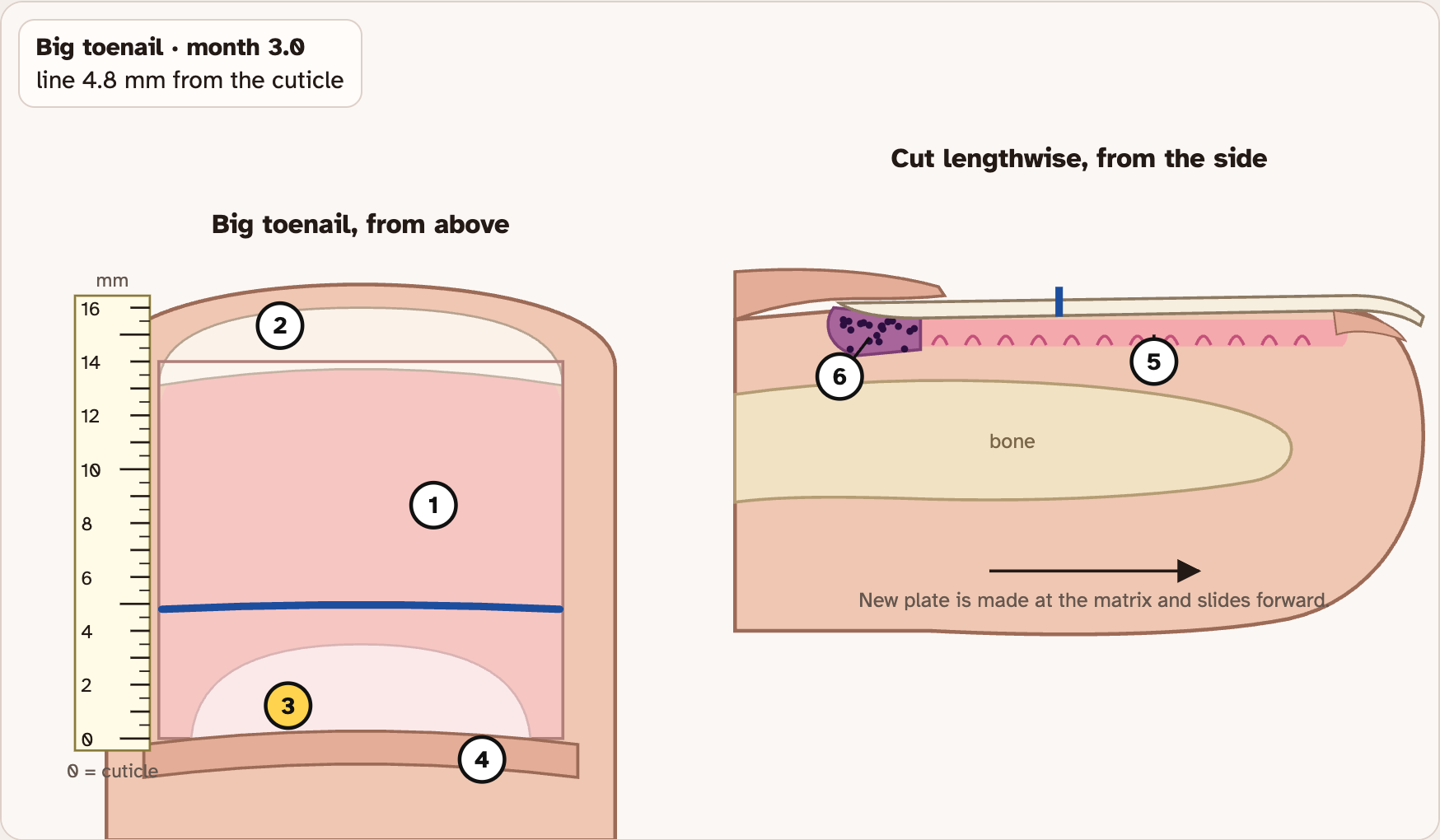
Left: the nail from above, with a ruler. Right: the fingertip cut lengthwise.
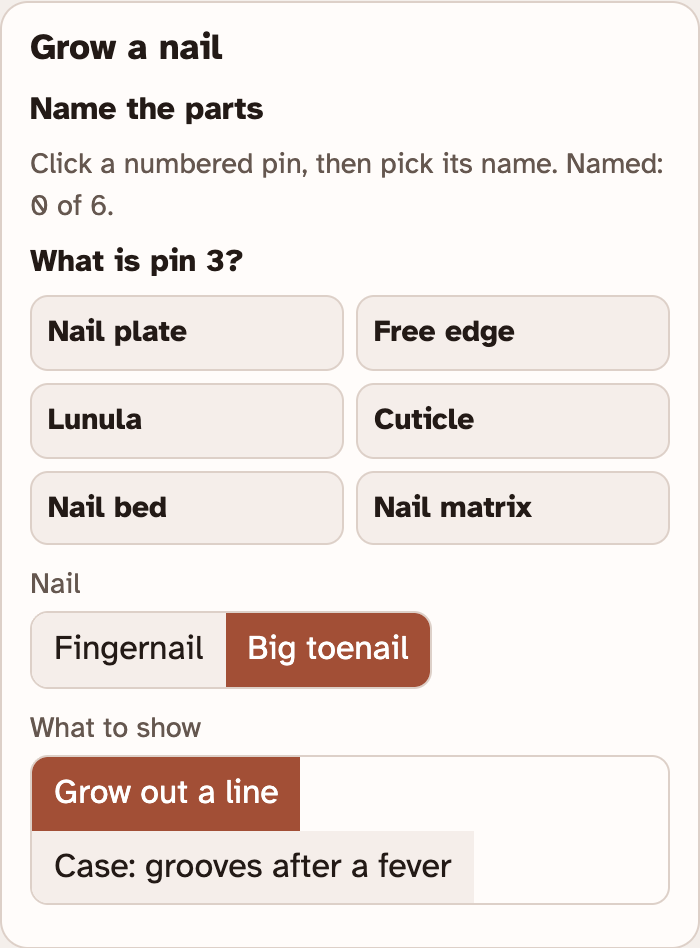
Screenshots: mrsajdak.com/skin-appendages, Tab 2
PART 2 · QUESTION 8
Grow out the blue line
1
Under What to show, pick Grow out a line. Pick Fingernail.
2
Drag the slider to month 2. Read Distance from cuticle. Press Record this reading.
3
Do the same at month 4.
4
Pick Big toenail. Do months 5 and 10.
5
Work out the mm per month. Then work out the months to the free edge.
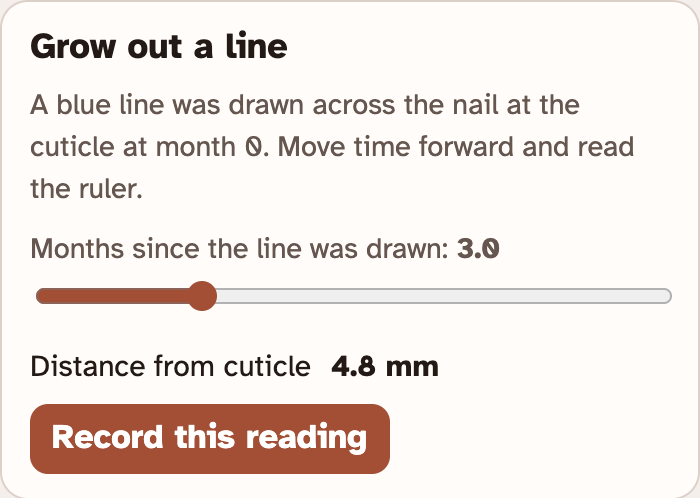
The ruler starts at the cuticle. 0 mm is the cuticle.
The nail ends at the free edge. Read its length on the ruler.
Example
A line is 6 mm from the cuticle at month 3.
6 ÷ 3 = 2
It moves 2 mm a month. A nail 12 mm long takes 12 ÷ 2 = 6 months.
These are not your numbers. Use your own.
Screenshots: mrsajdak.com/skin-appendages, Tab 2
PART 2 · QUESTION 9
A groove that tells time
1
Under What to show, pick Case: grooves after a fever.
2
Click the groove on the nail. The lab shows how far it is from the cuticle.
3
Divide by the mm per month from Question 8.
4
Type the months. Press Check.
5
Switch to the other nail. Do it again. Do both nails point to the same time?
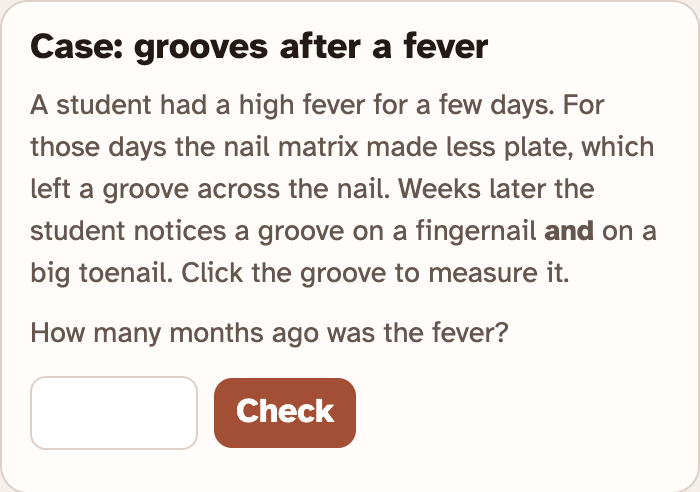
Read the story in this card first.
Example
A groove is 9 mm from the cuticle.
That nail grows 3 mm a month.
9 ÷ 3 = 3
The groove was made 3 months ago.
These are not your numbers. Use your own.
Screenshots: mrsajdak.com/skin-appendages, Tab 2
DAY 1 · TAB 3 · QUESTIONS 10 TO 12
Part 3. Hair evidence
A window was broken in a garden shed. One hair was caught on the frame.
You will measure it under a microscope. Then you will compare it with three hairs and a fiber.
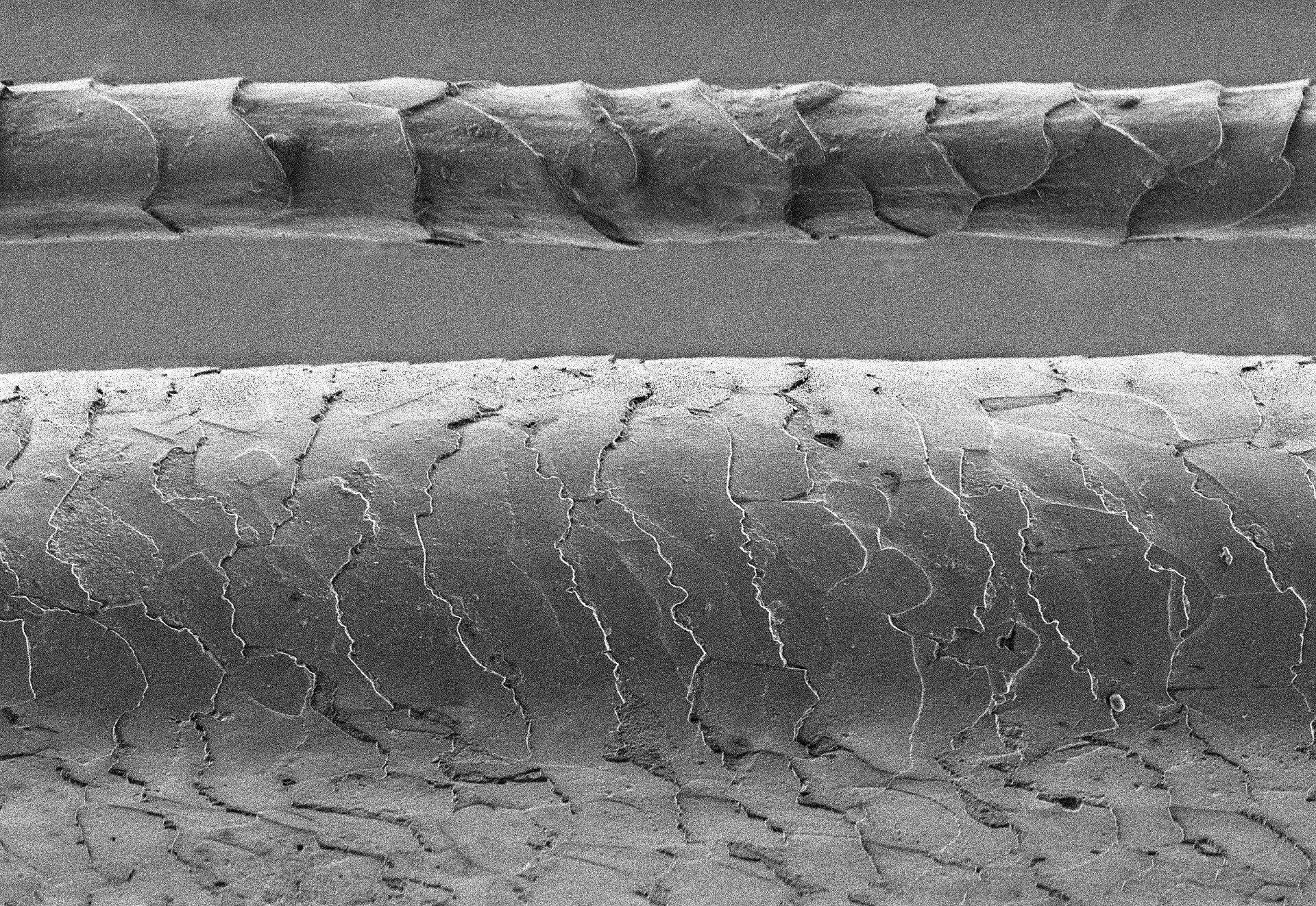
Photo: CSIRO, CC BY 3.0
PART 3 · QUESTION 10
Measure with the blue lines
1
Pick a Sample. You will do all five. Keep Focus on set to Inside.
2
Drag the two blue lines onto the top and bottom edges of the hair.
3
Press Record as hair width.
4
Now put the lines on the edges of the dark core. That core is the medulla. Press Record as medulla width.
5
No dark core? Press No medulla: record 0.
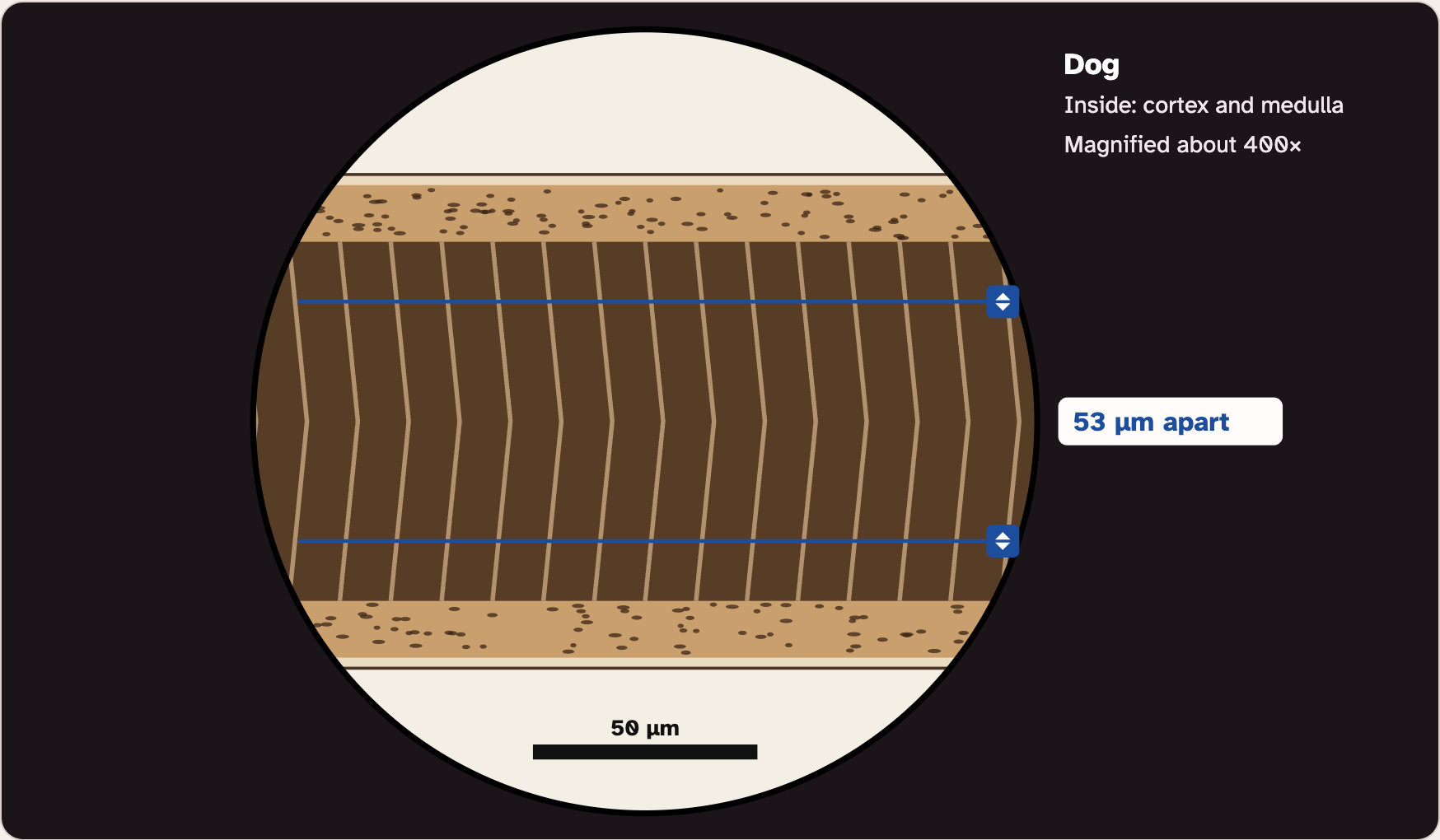
The blue lines in this picture are not on the edges yet.
The up and down arrow keys nudge a line a tiny bit.
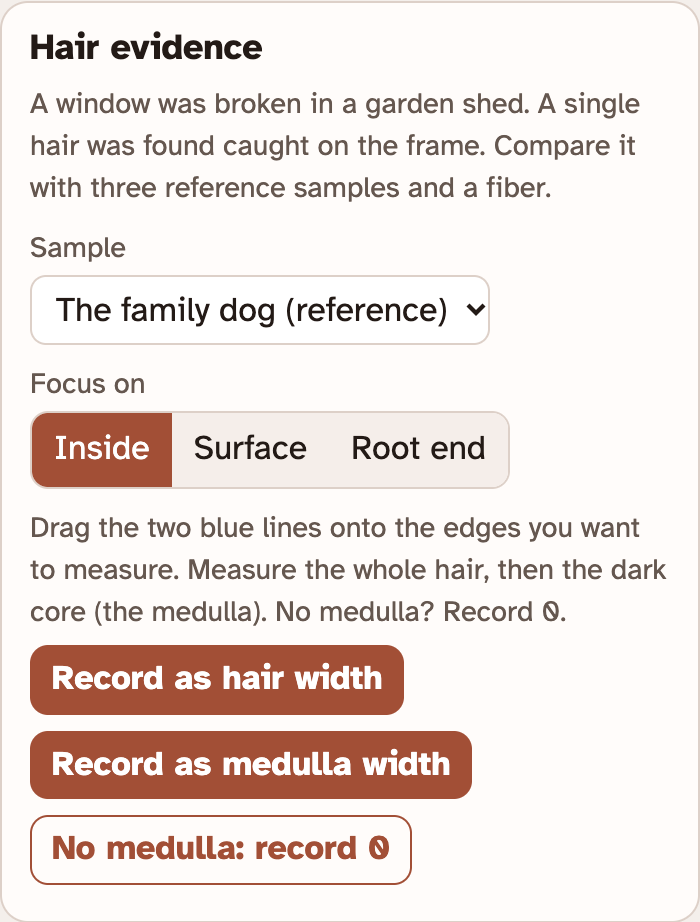
Screenshots: mrsajdak.com/skin-appendages, Tab 3
PART 3 · QUESTIONS 10 TO 12
Index, root, verdict
QUESTION 10
Medullary index
Divide the medulla width by the hair width. Type it in the lab. Press Check.
Read the rule on the Medullary index card. Human, animal, or not a hair?
QUESTION 11
Look at the root
Pick Hair from the scene. Set Focus on to Root end.
Read the label under the root. Then read the note in the Hair evidence box.
QUESTION 12
Your verdict
Measure the scene hair, Person A, Person B and the dog. Then pick under Your verdict.
Why can a microscope not prove whose hair it is?
Example
30 ÷ 100 = 0.30
A medulla 30 µm wide in a hair 100 µm wide. Round to two decimal places. These are not your numbers.
DAY 2 · TAB 4 · QUESTIONS 13 TO 16
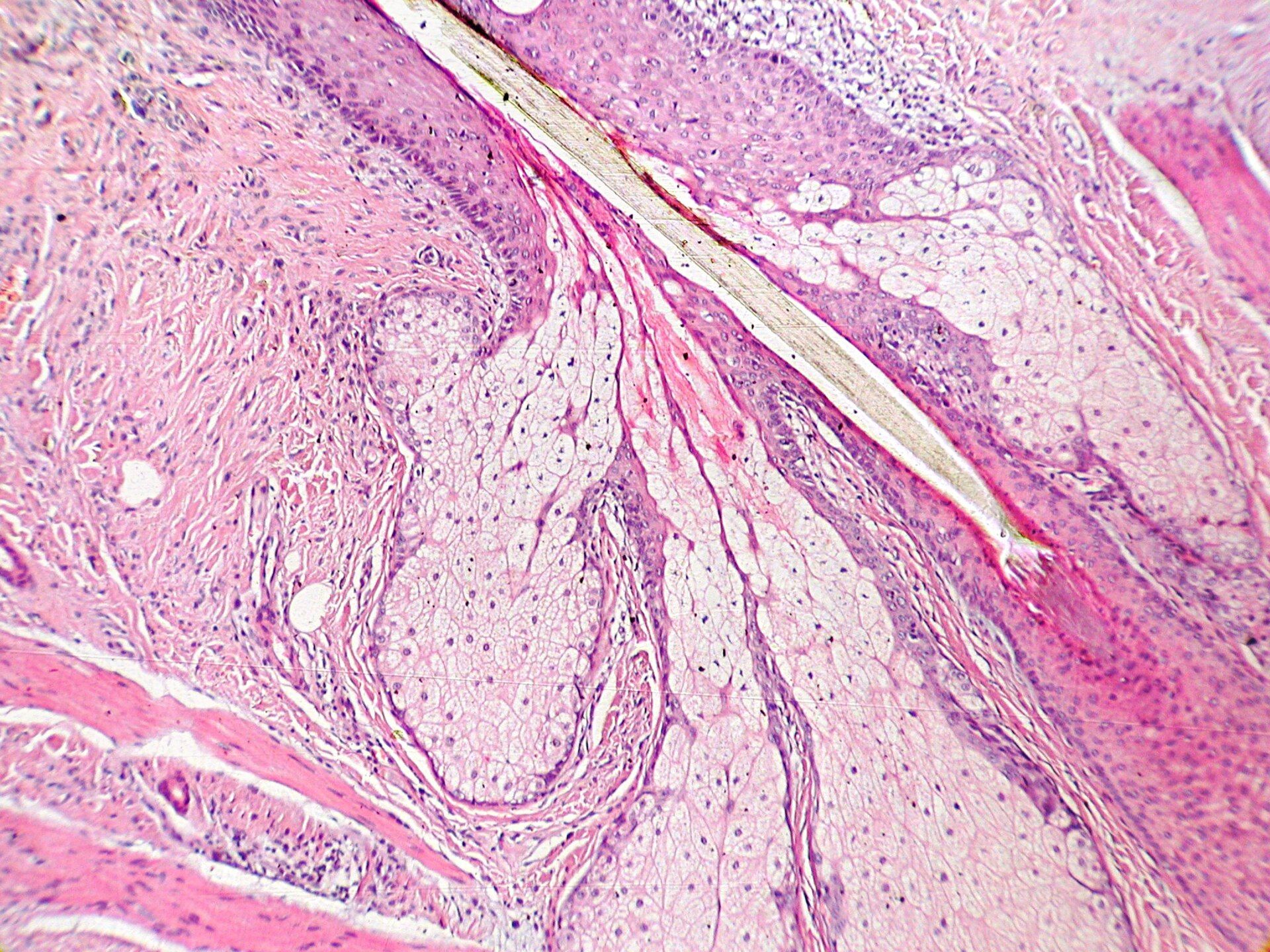
Part 4. Three glands
A gland is a group of cells that makes something and lets it out.
Three kinds of gland sit in your dermis. Two make sweat. One makes oil. You will find all three.
Photo: Kilbad, public domain
PART 4 · QUESTION 13
Find the three glands
1
Under Skin from the, pick Armpit. Set Age to 16.
2
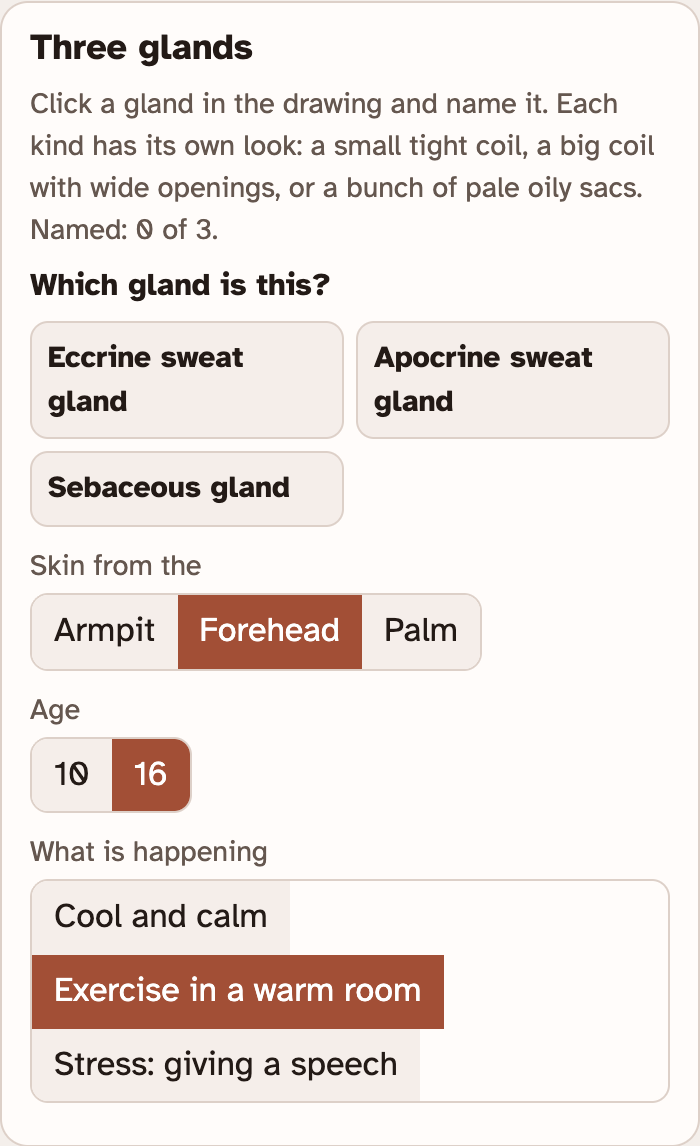
Click a gland in the drawing. Pick its name.
3
Read its card: Opens onto, Makes and Found.
4
Name all three. Fill in the Question 13 table.
5
For What it looks like, use your own words. Coil or sacs? Big or small?
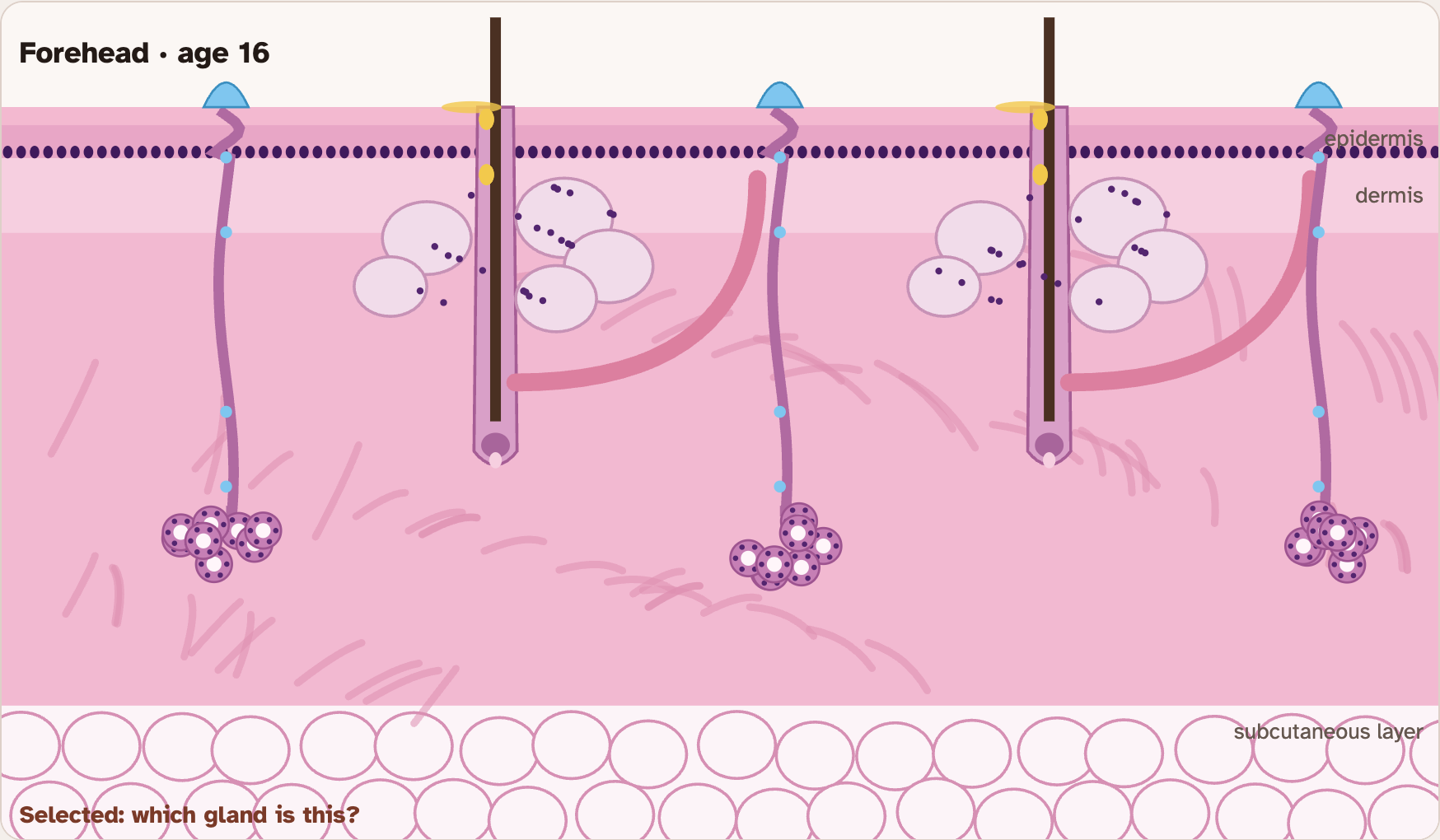
This picture is the forehead. You start with the armpit.
Click the hair itself and the lab tells you it is not a gland.
Screenshots: mrsajdak.com/skin-appendages, Tab 4
PART 4 · QUESTIONS 14 TO 16
What switches each gland on?
QUESTION 14
3 tests
Calm, exercise, stress
Stay on Armpit, age 16. Try all three settings under What is happening.
Read What comes out now. Tick every gland that lets something out.
QUESTION 15
10 or 16
What changes with age?
Set Age to 10. Pick Stress: giving a speech.
Now switch back to 16. Two glands change. Say how.
QUESTION 16
Palm
What is missing?
Under Skin from the, pick Palm.
Which glands are gone? Look at where those glands open in your Question 13 table.
DAY 2 · TAB 5 · QUESTIONS 17 TO 20
Part 5. Sweat-print test
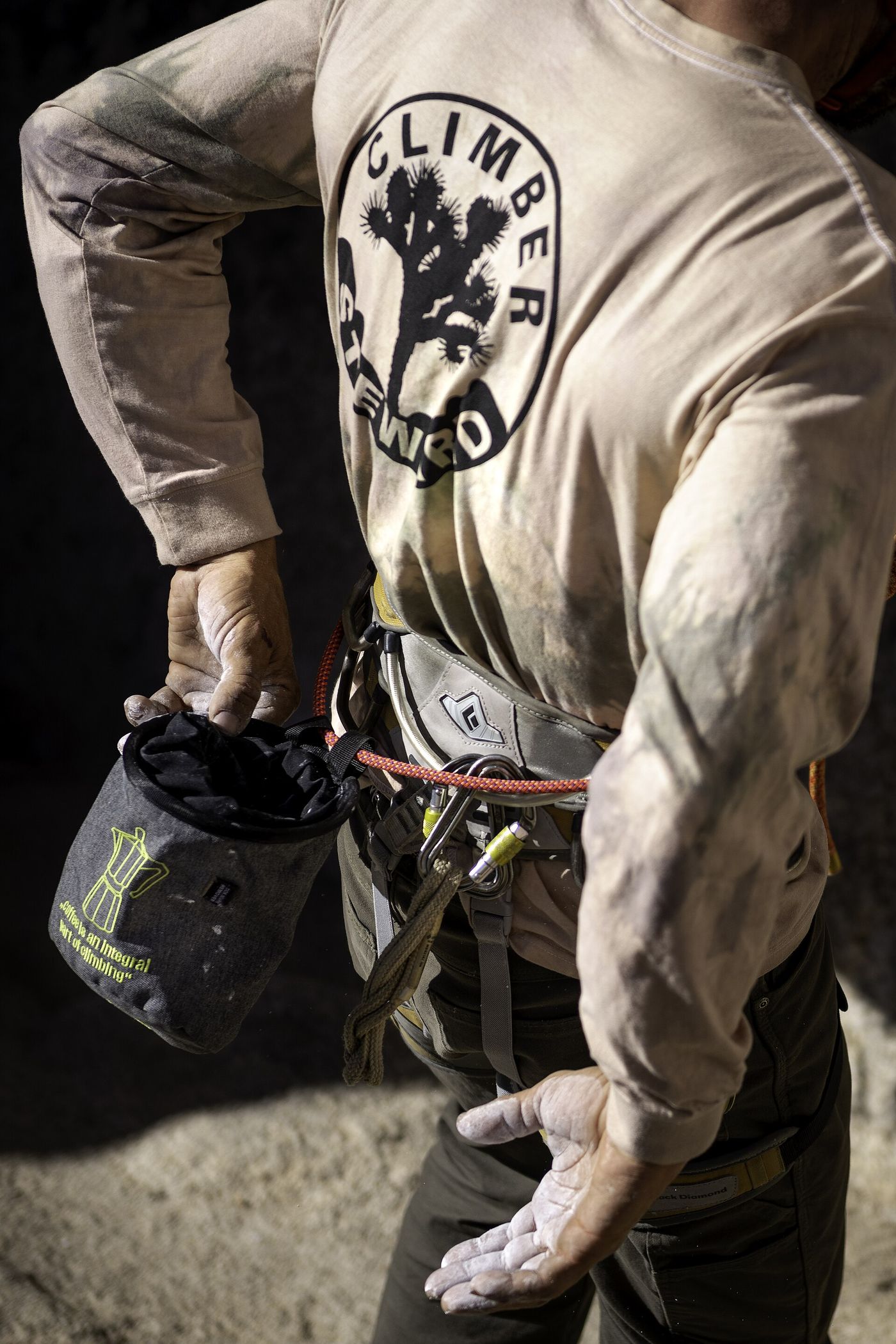
Rock climbers dust their hands with chalk. It soaks up sweat.
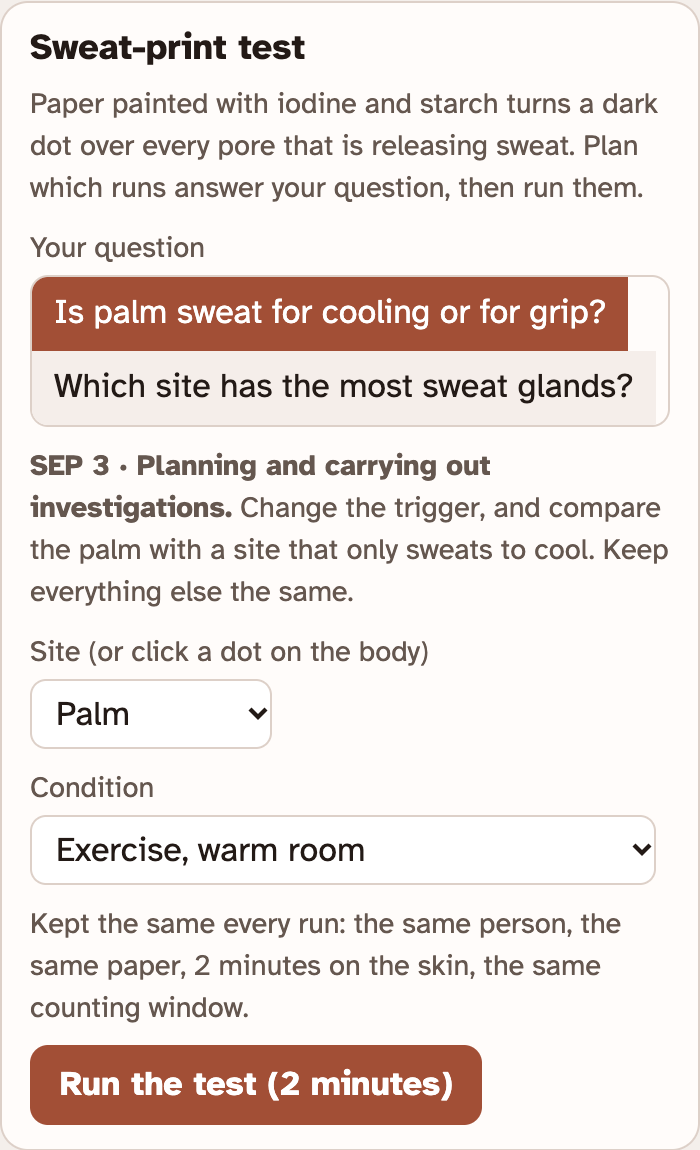
Is palm sweat for cooling or for grip? You will plan a test. Then you will count sweat pores.
Photo: Emily Hassell, National Park Service
PART 5 · QUESTION 17
Plan a fair test
The question
Is palm sweat for cooling or for grip? Pick it under Your question.
What to change
Read the note under the question in the lab. It tells you what to change and what to compare.
List the runs
One run is one site and one condition. The Question 18 table shows the runs you need.
Keep the same
The lab lists what stays the same in every run. Name two of those things.
Screenshots: mrsajdak.com/skin-appendages, Tab 5
PART 5 · QUESTION 18
Run it and count the dots
1
Pick the Site and the Condition.
2
Press Run the test (2 minutes). It only takes a few seconds.
3
Count the dark dots inside the red window. Click each dot to mark it.
4
Type your count. Press Record.
5
Multiply by 20. That is the glands per cm².
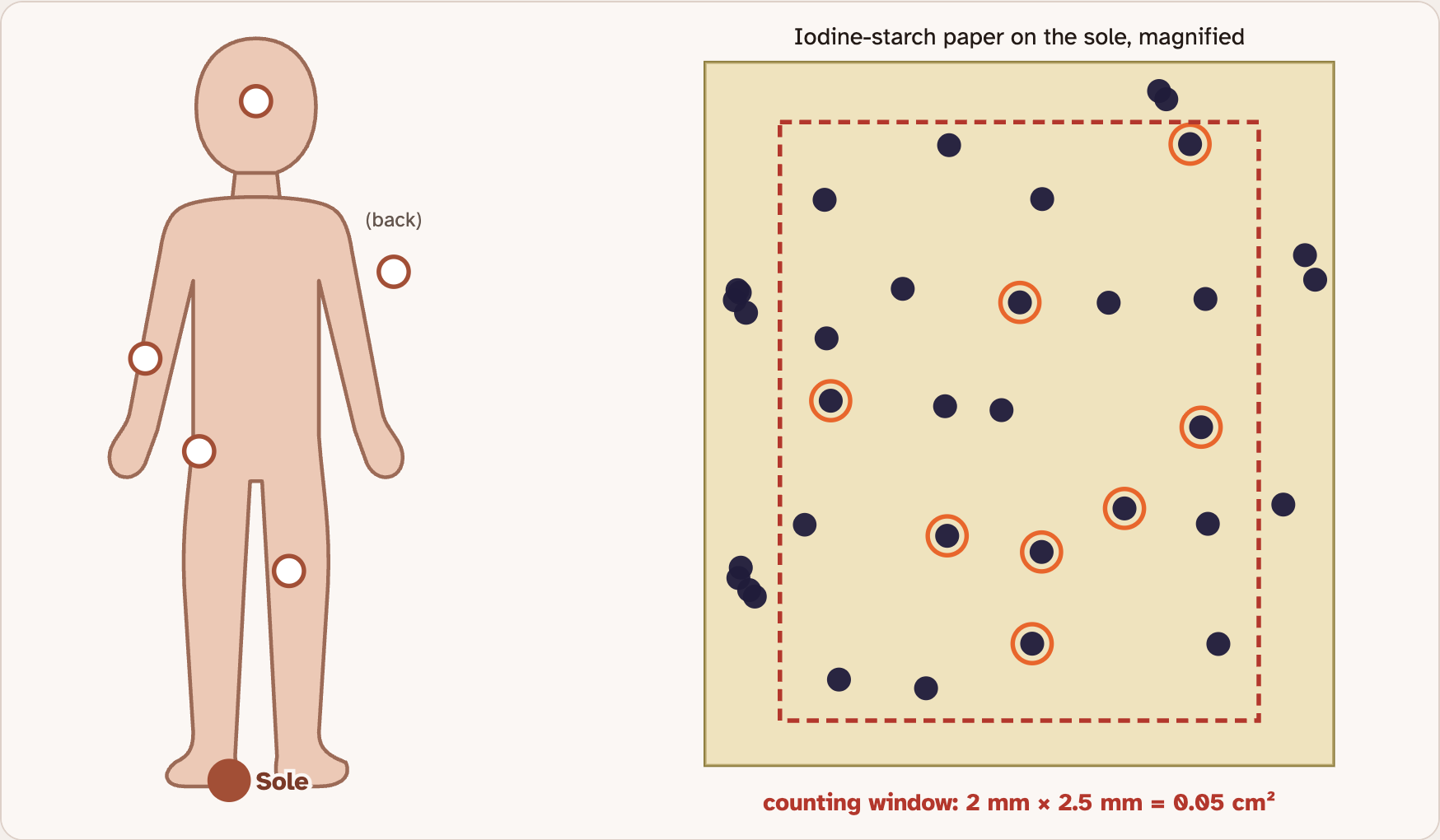
Each dark dot is one sweat pore that is working.
This run is the sole. It is not in your table.
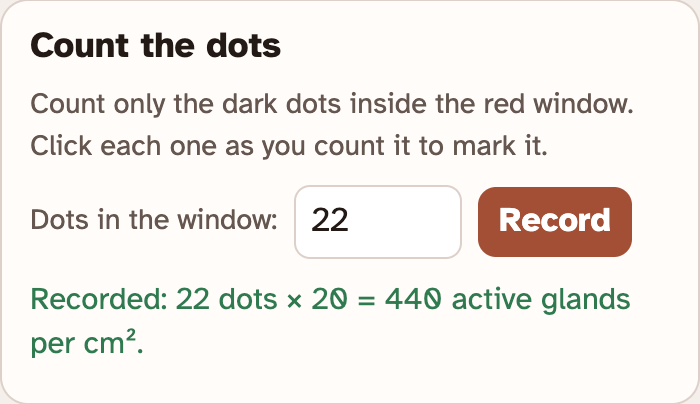
Why × 20? The window is 0.05 cm². Twenty windows make 1 cm².
Miss by more than 1 and the lab asks you to count again.
Screenshots: mrsajdak.com/skin-appendages, Tab 5
PART 5 · QUESTION 19
Switch every gland on
1
Under Your question, pick Which site has the most sweat glands?
2
Set Condition to Every gland switched on (pilocarpine).
3
Run all six sites. Palm, Sole, Forehead, Forearm, Upper back, Thigh.
4
Count, record and multiply by 20 each time.
5
Copy your six rows from Your runs.
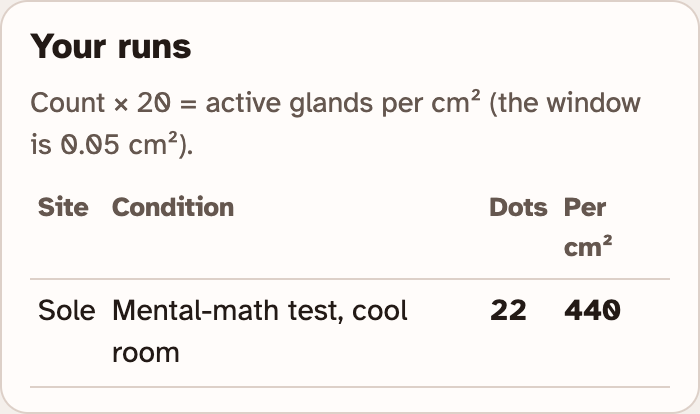
Pilocarpine is a medicine. It turns on every sweat gland, so every one shows on the paper.
You can also click a dot on the body to pick a site.
Screenshot: mrsajdak.com/skin-appendages, Tab 5
WRAP IT UP · QUESTION 20
Grip or cooling?
The claim
“Palm sweat glands are mostly for grip. Back sweat glands are for cooling.”
Evidence
Use numbers from your Question 18 table. Compare the palm and the back in each condition.
Reasoning
What switched each site on the most? Link that trigger to the job.
One more
Say what the apocrine glands respond to. Look back at Question 14.
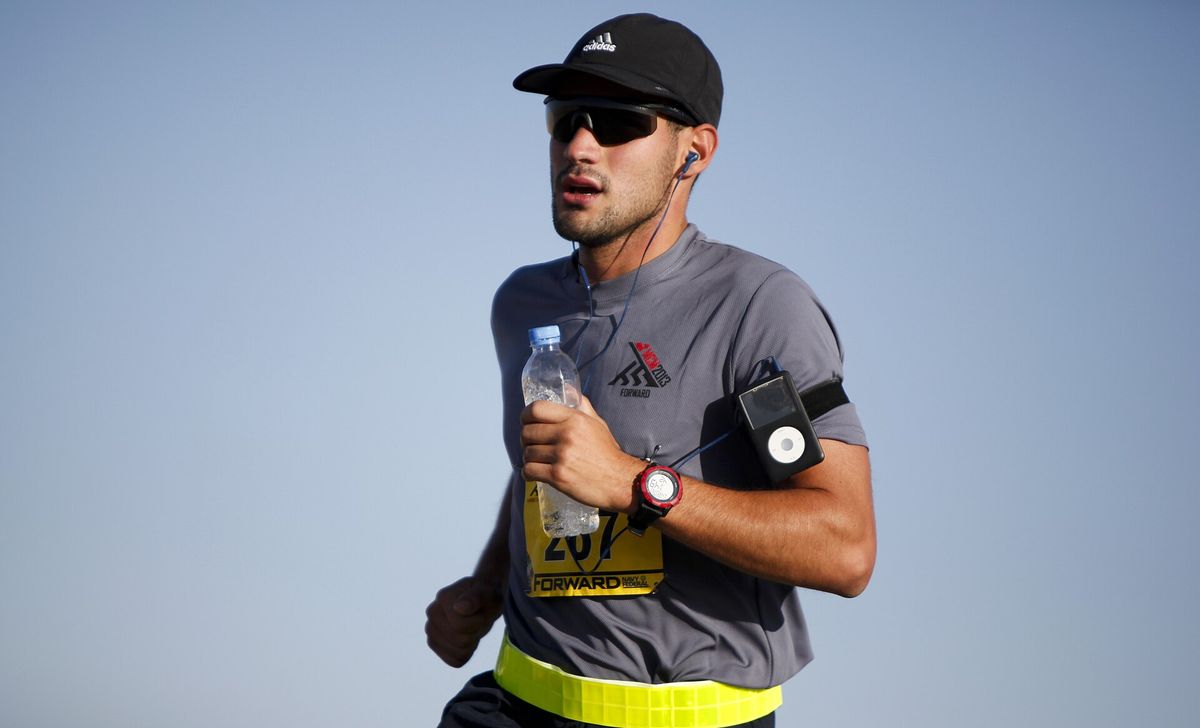
A runner in a marathon in 2013. Sweat that dries on the skin carries heat away.
Photo: Sgt. Bobby Yarbrough, U.S. Marine Corps
LAST CHECK
Before you hand it in
Name, date and period are on top.
Both sides are done: Day 1 and Day 2.
Every table is full.
Your explanations use numbers from your own tables.
Photo: Giulia Bertelli, CC0