CHEMISTRY · ATOMIC STRUCTURE
Atomic Spectra Virtual Lab
Follow along with your worksheet, one question at a time.
mrsajdak.com/spectra
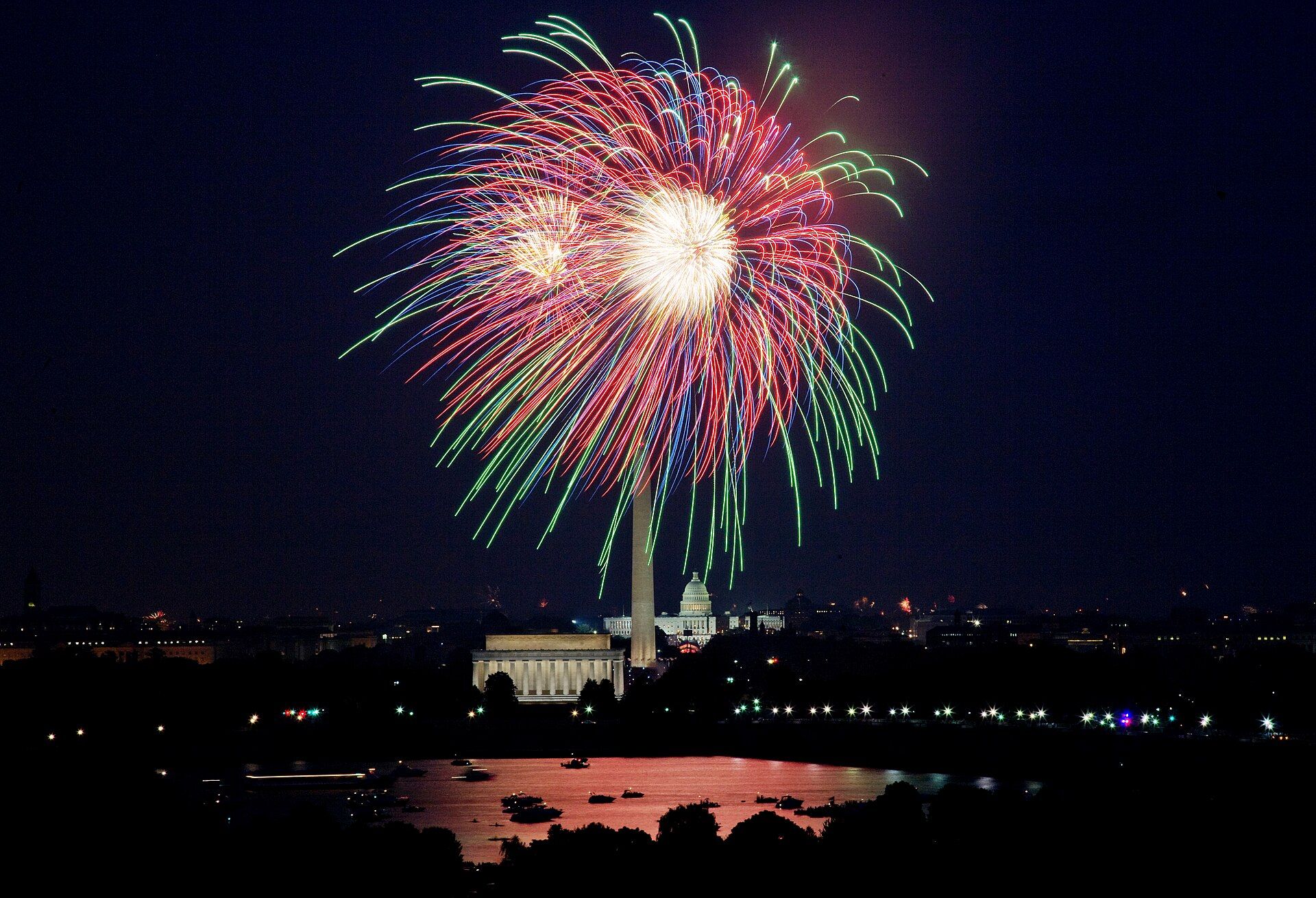
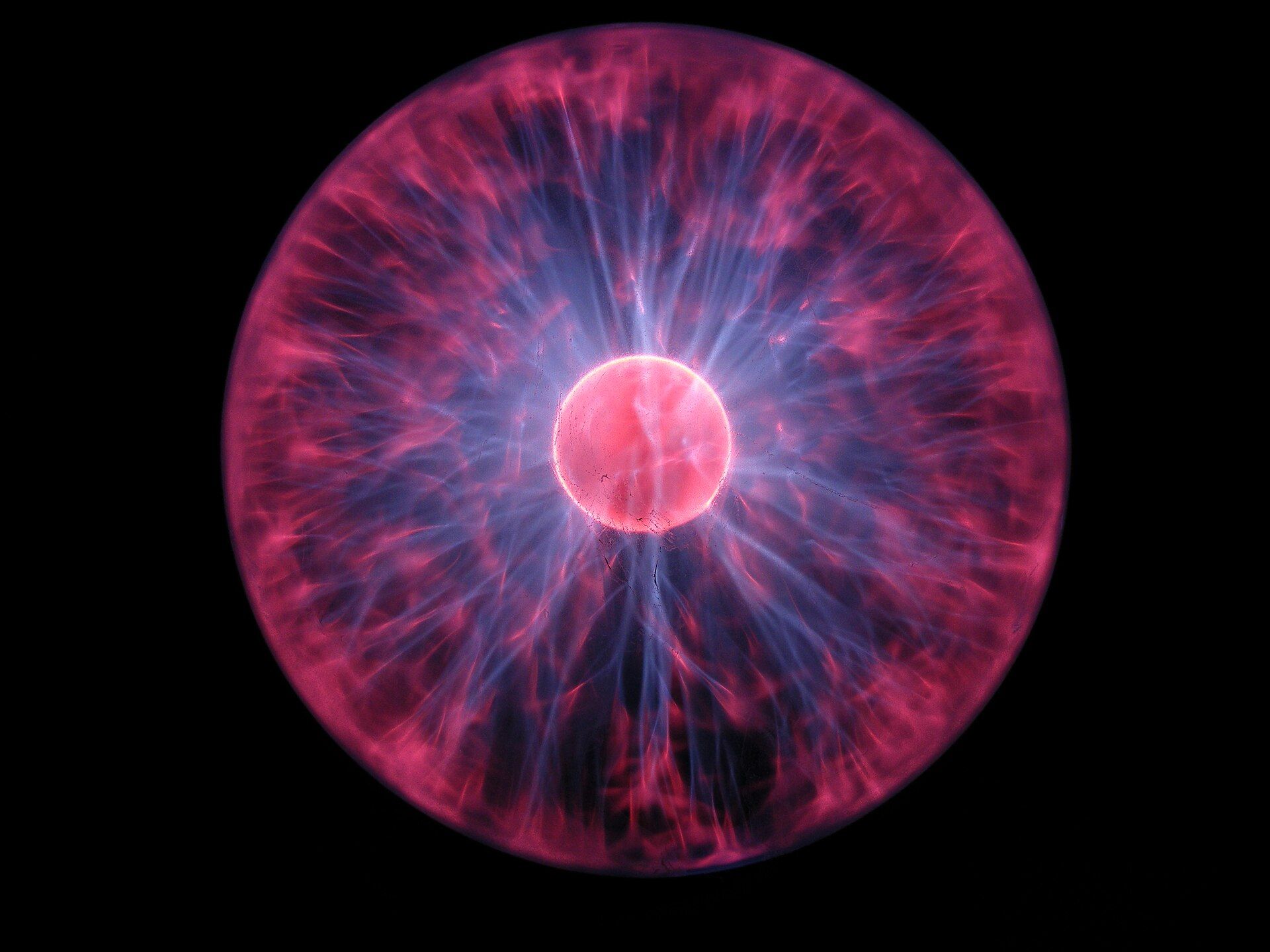
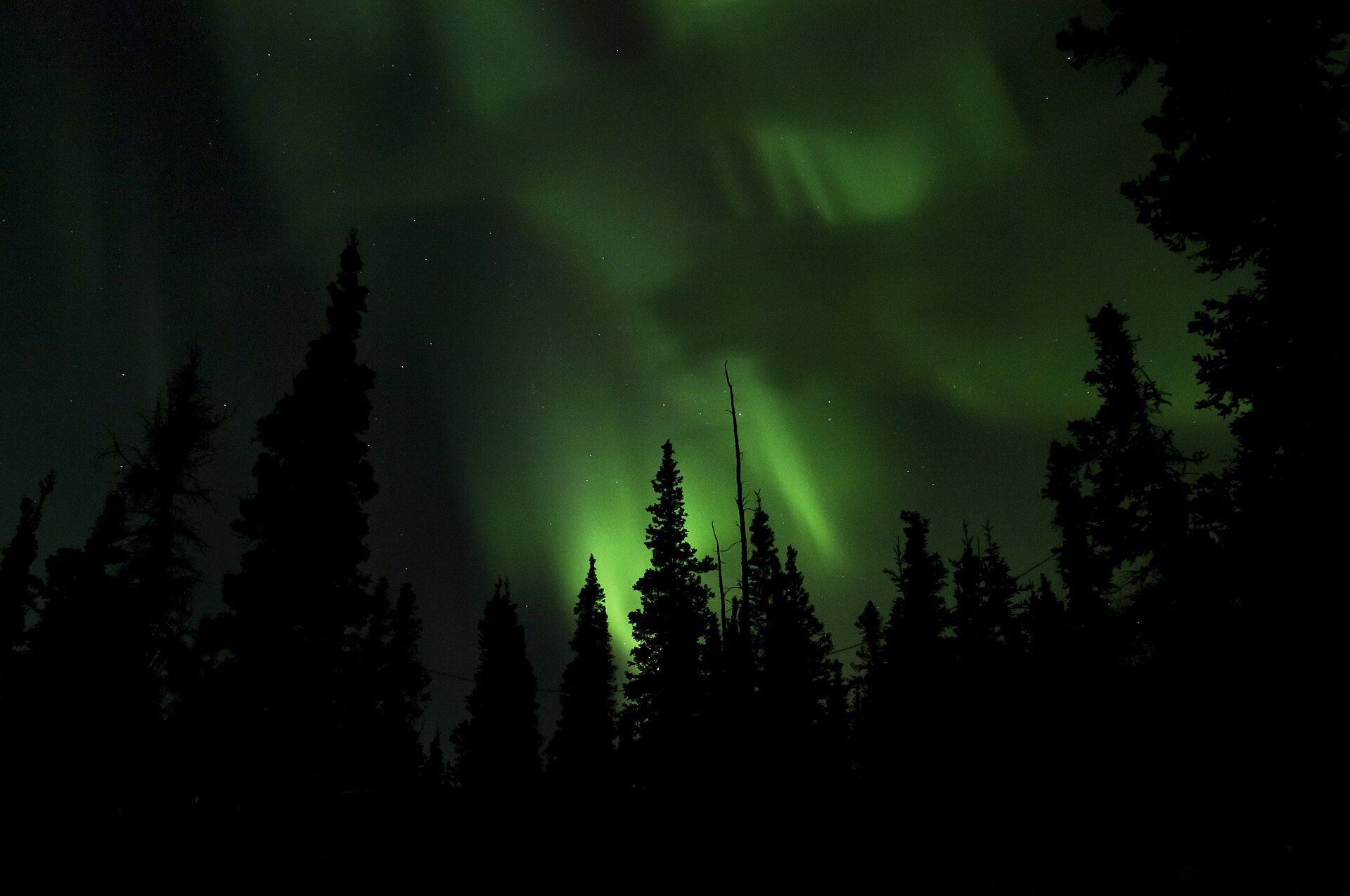
Photo: National Park Service
BEFORE YOU START
Light from atoms
Words you will use
Energy level: a fixed place an electron can be.
Photon: a tiny packet of light.
Wavelength: the length of one wave of light, in nm.
Emission spectrum: the set of colors an element gives off.
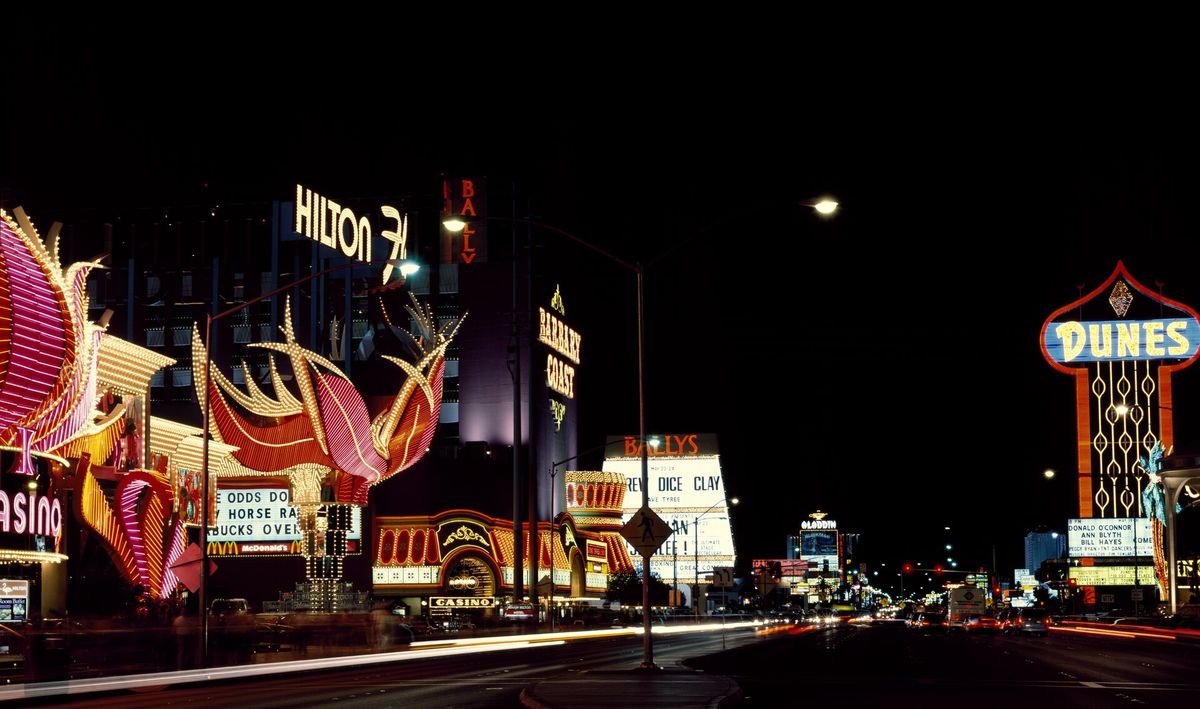
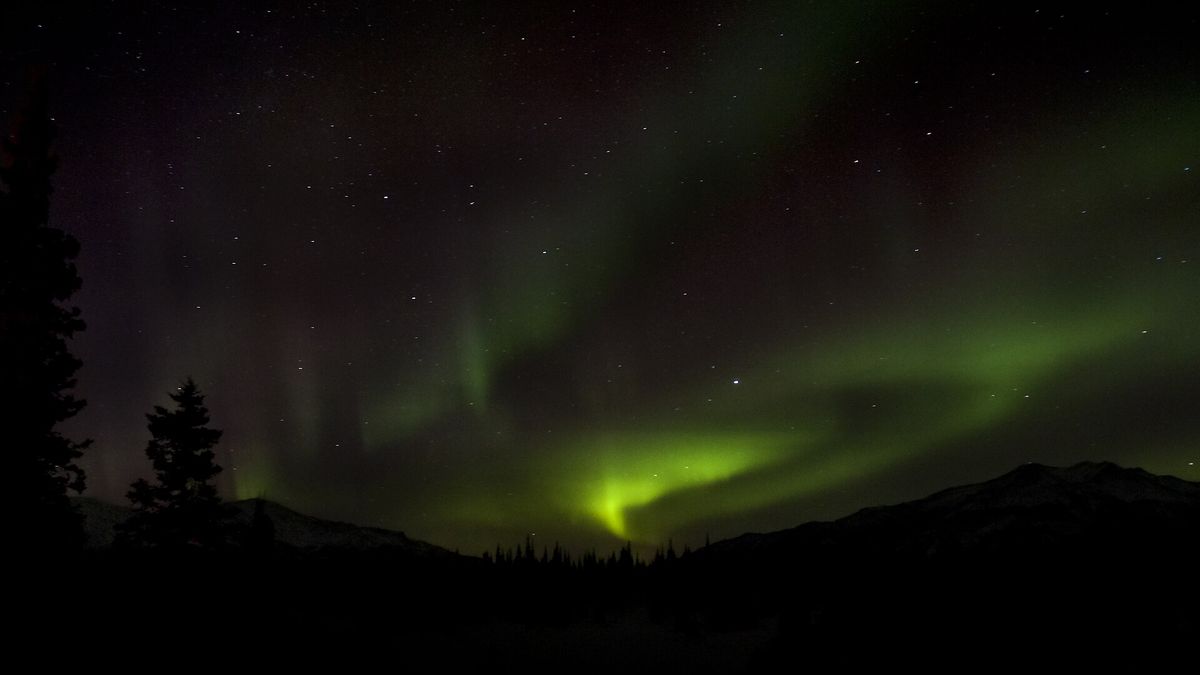
Different gases glow different colors. Why? Can light tell you what a gas is?
Photos: Carol M. Highsmith, Library of Congress · NPS / Tim Rains
BEFORE YOU START
Get set up
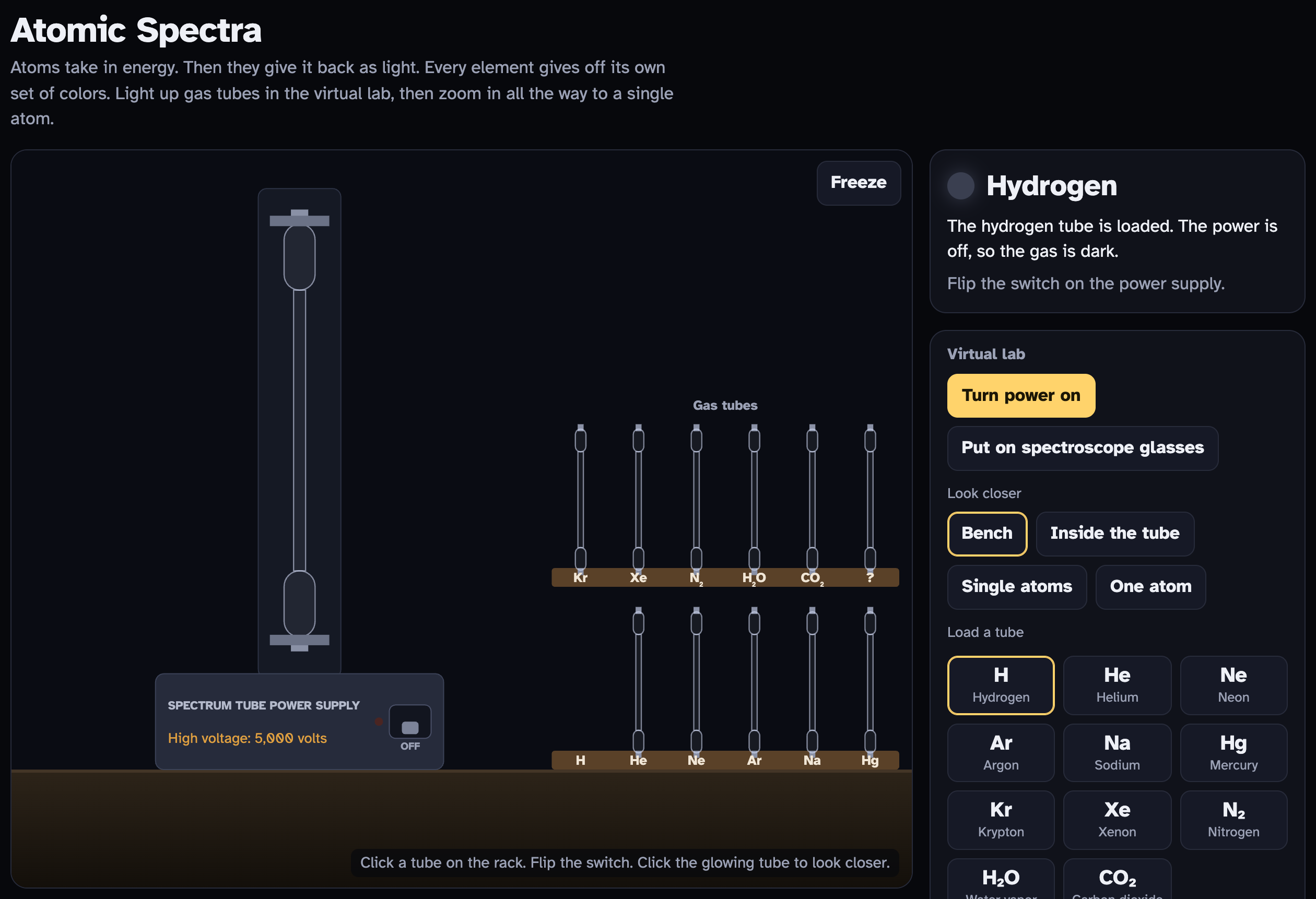
The picture shows the lab bench. The Virtual lab box is beside it.
1
Open mrsajdak.com/spectra on your device.
2
Write your name, the date and your period on the worksheet.
3
Find the Look closer buttons. They zoom in, all the way to one atom.
| Worksheet | Look closer | Questions |
|---|---|---|
| Part 1. Light it up | Bench | 1 to 5 |
| Part 2. Inside the tube | Inside the tube | 6 to 8 |
| Part 3. One hydrogen atom | One atom | 9 to 12 |
| Part 4. Mystery tubes | Bench | 13 |
| Part 5 and Wrap it up | Bench | 14 to 16 |
Screenshot: mrsajdak.com/spectra
BENCH · QUESTIONS 1 TO 5
Part 1. Light it up
A gas tube is a sealed glass tube with a little gas inside.
You will send electricity through four gases. Then you will look at each glow through spectroscope glasses.
Photo: Supportstorm, public domain
PART 1 · QUESTIONS 1 AND 2
Light a tube. Put on the glasses.
1
Click the H tube on the rack. Or press H under Load a tube.
2
Flip the switch on the power supply. Or press Turn power on.
3
Look at the glow. Write its color for Question 1.
4
Press Put on spectroscope glasses.
5
Watch the glow change. Write what happened for Question 2.
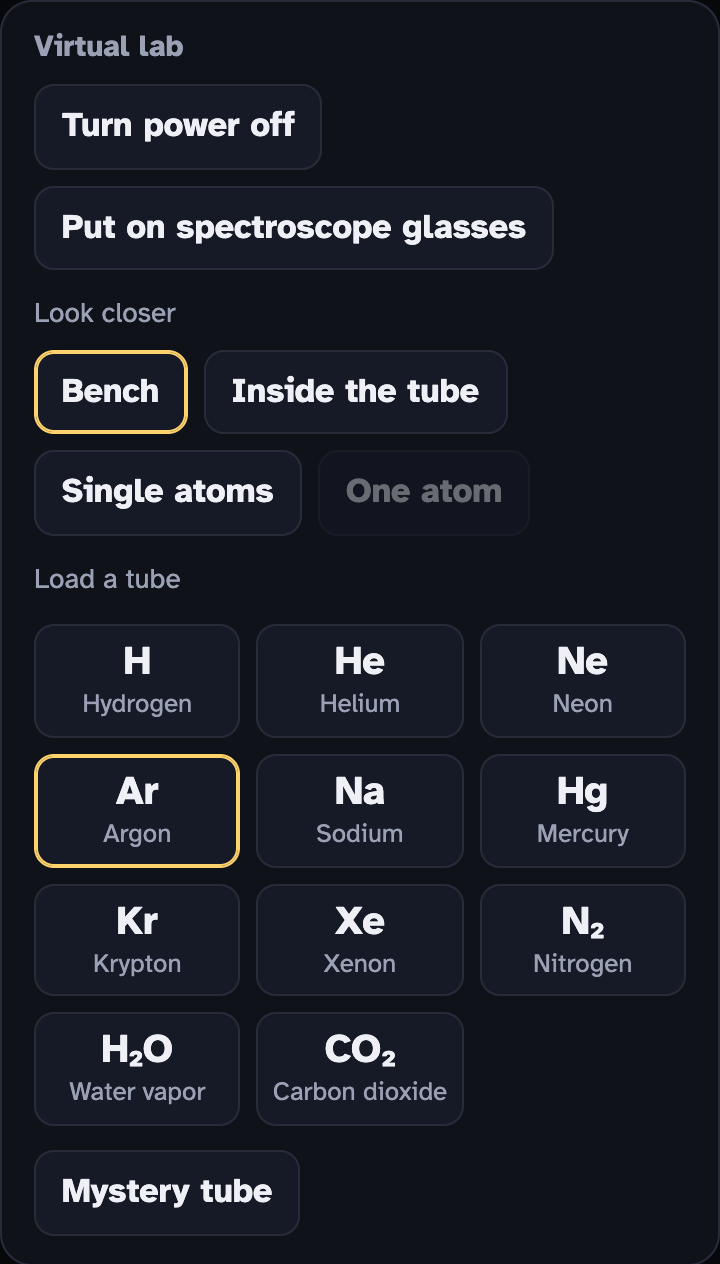
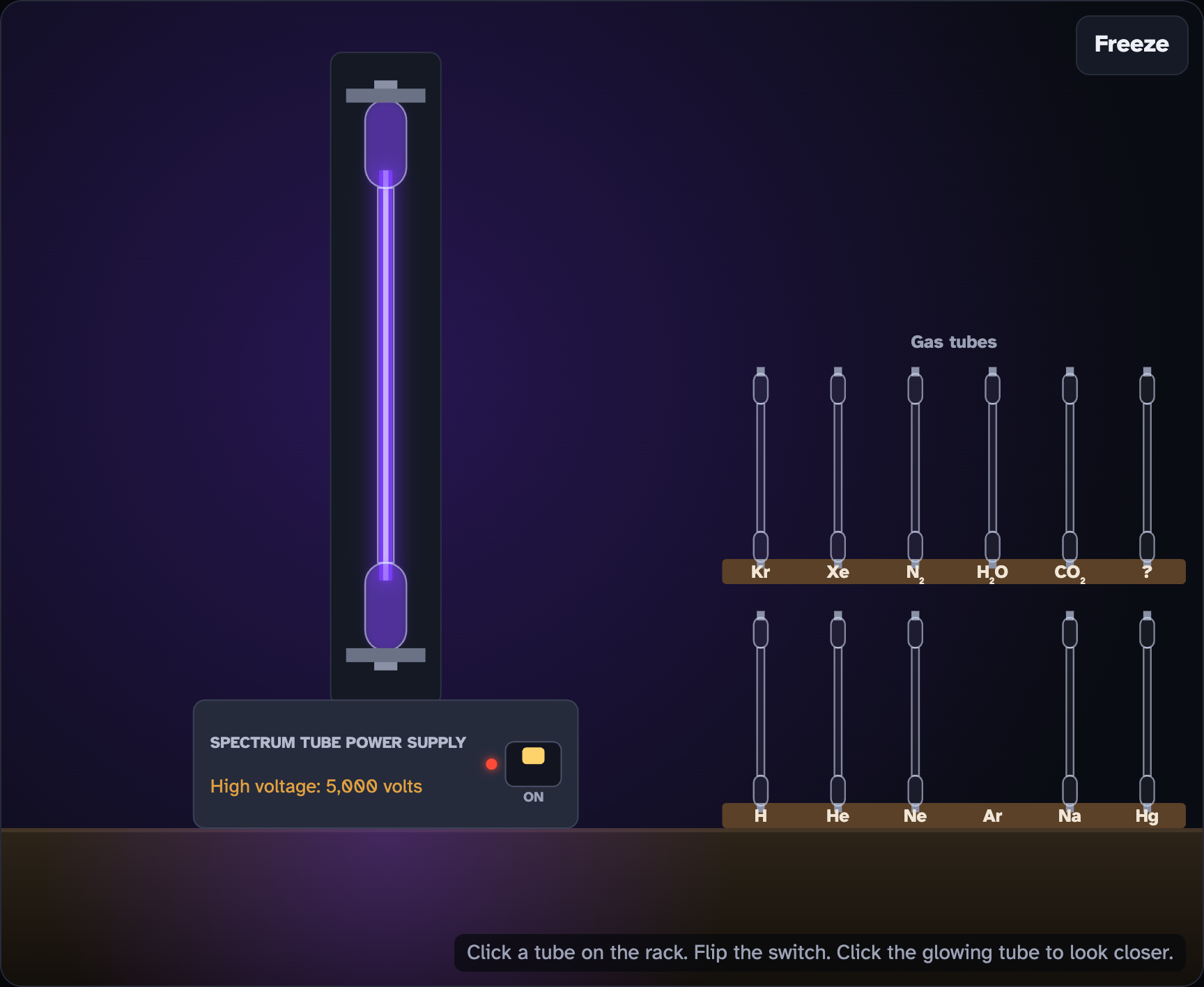
The tube in this picture is argon, not hydrogen.
The power supply holds one tube at a time.
Screenshots: mrsajdak.com/spectra, Bench view
PART 1 · QUESTION 3
Draw the bright lines
1
Load the tube. Turn the power on. Put on the glasses.
2
Find the box under the picture. It is called What a spectroscope would show.
3
Many lines have a number. That is the wavelength in nm.
4
Find that number on your worksheet scale. Draw the line there. Color it in.
5
Do hydrogen, helium, neon and mercury.
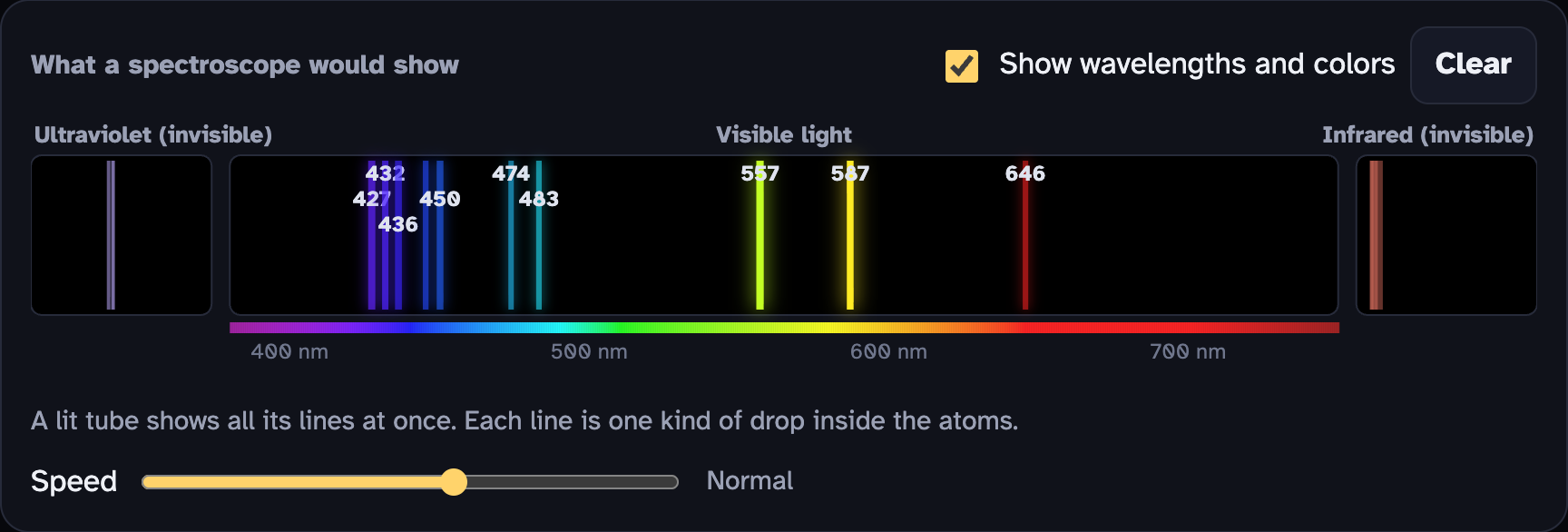
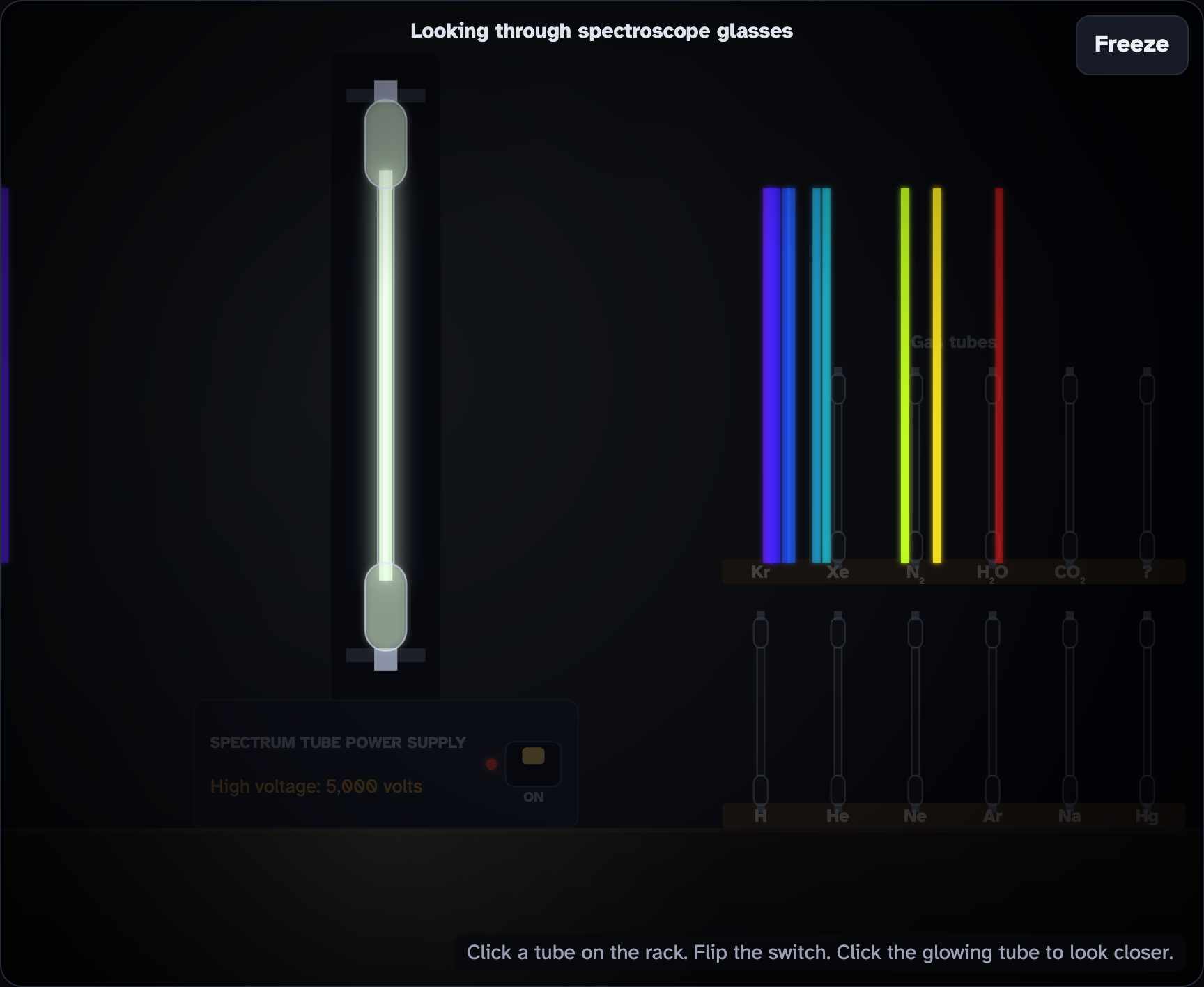
Example
This tube is krypton. One line is marked 557.
Draw it a little past halfway from 500 to 600. Color it green.
Krypton is not on your worksheet.
Screenshots: mrsajdak.com/spectra, krypton through the glasses
PART 1 · QUESTIONS 4 AND 5
Glow, lines, and which tells you more
QUESTION 4
Glow
Color of the glow
Take the glasses off. Write the color of the whole tube.
The box at the top right names the color too.
QUESTION 4
Lines
How many? Which is brightest?
Put the glasses on. Count the lines in the Visible light box.
Lots of lines? Write “about” and your best count.
QUESTION 5
Why?
Color or lines?
Two tubes can glow almost the same color.
Scroll down to the Fingerprints chart. Compare the rows. Are any two the same?
INSIDE THE TUBE · QUESTIONS 6 TO 8
Part 2. Inside the tube
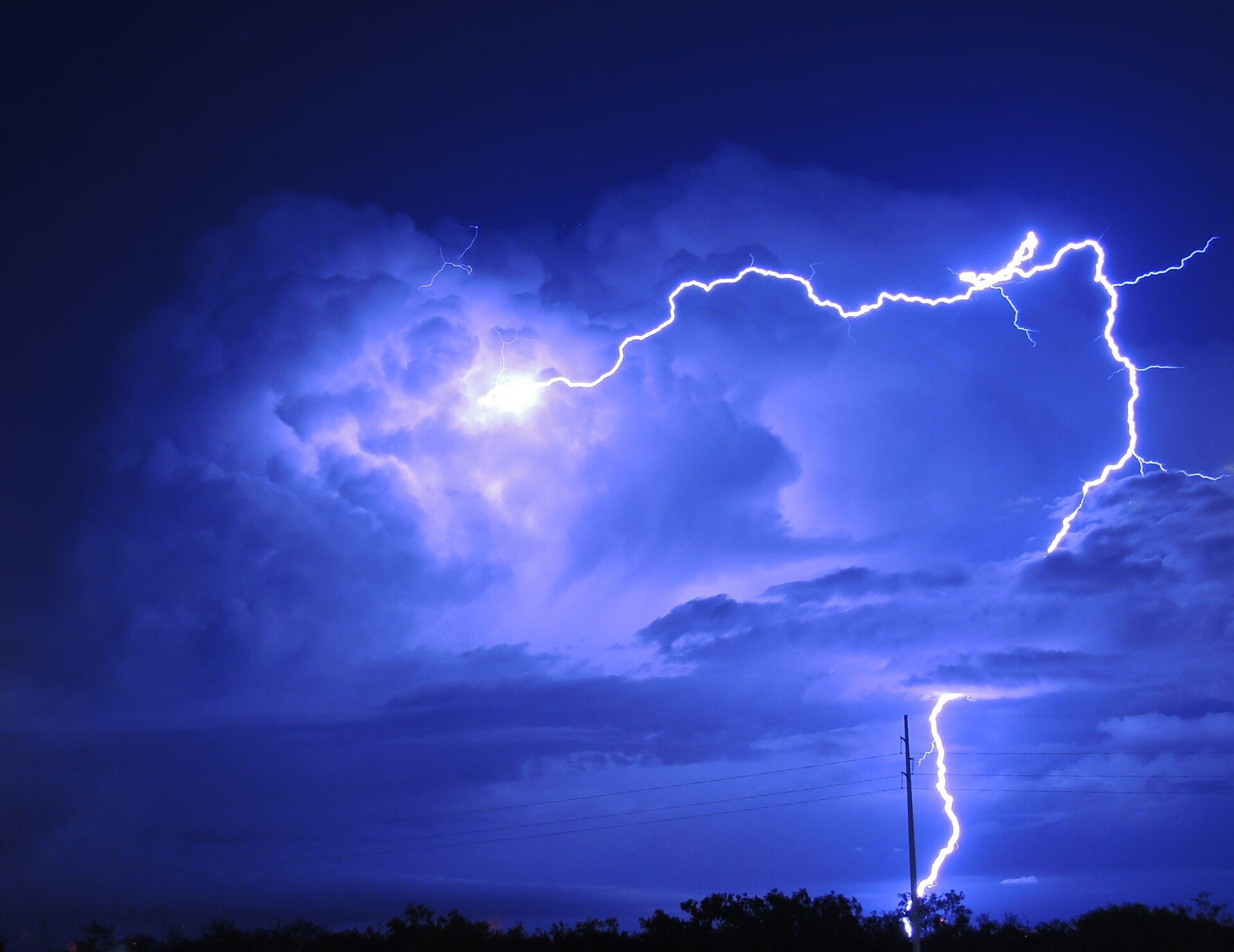
Lightning is electricity racing through a gas. The gas is air.
A gas tube works the same way. Zoom in. Watch what the electricity does to the atoms.
Photo: Mitchel Coombs, NOAA Weather in Focus
PART 2 · QUESTION 6
Zoom in on the glowing tube
1
Load any tube. Turn the power on.
2
Click the glowing tube. Or press Inside the tube.
3
Watch the small blue dots. Which way do they go?
4
Read the words beside the tube in the picture.
5
Answer Question 6. What are the dots? Where do they come from?
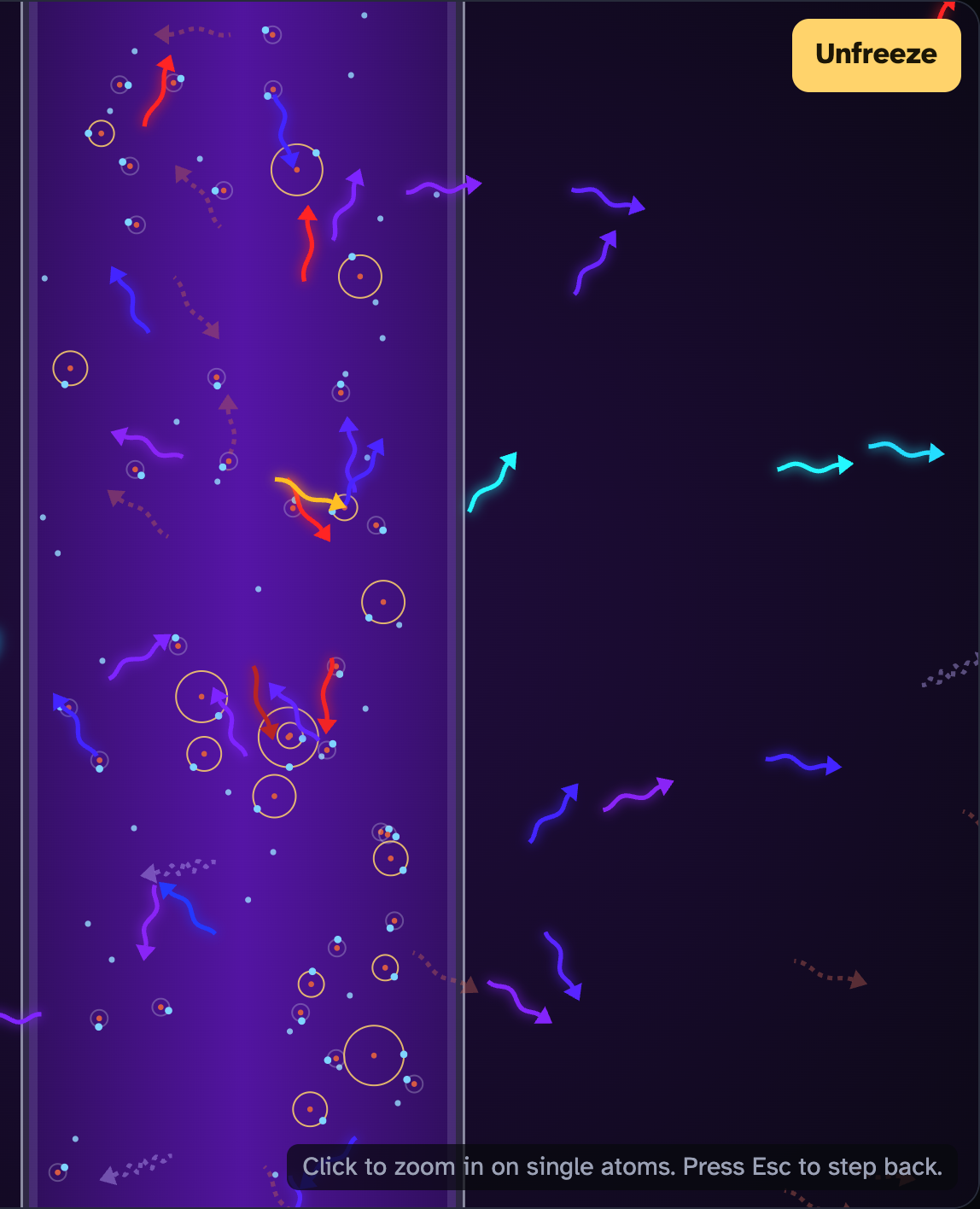
The circles are atoms. The wavy arrows are photons.
A dashed arrow is light you cannot see.
Press Esc to step back out.
Screenshots: mrsajdak.com/spectra, Inside the tube
PART 2 · QUESTIONS 7 AND 8
Freeze it and look closely
1
Press Single atoms to zoom in more.
2
Press Freeze. Everything stops.
3
Find an atom with a wavy arrow leaving it. That arrow is a photon.
4
Press Unfreeze. Watch one atom from start to finish.
5
Answer Question 7. What happened to the atom just before the photon left?
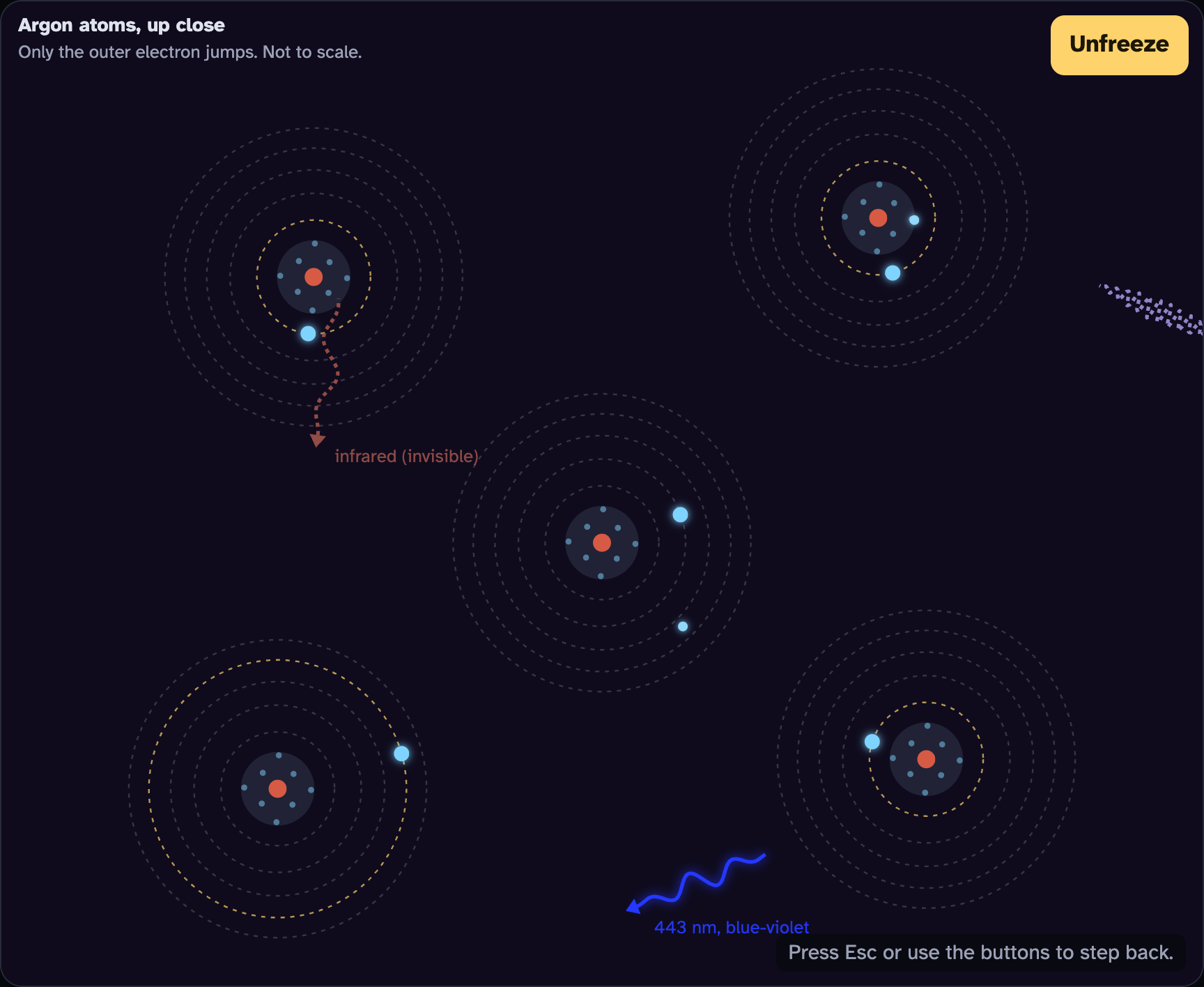
The Freeze button is in the top corner of the picture.
It says Unfreeze while the lab is stopped.
These atoms are argon.
QUESTION 8
The lab says “Not to scale.” Think about the size of real atoms and the space between them. Name one difference.
Screenshot: mrsajdak.com/spectra, Single atoms
ONE ATOM · QUESTIONS 9 TO 12
Part 3. One hydrogen atom
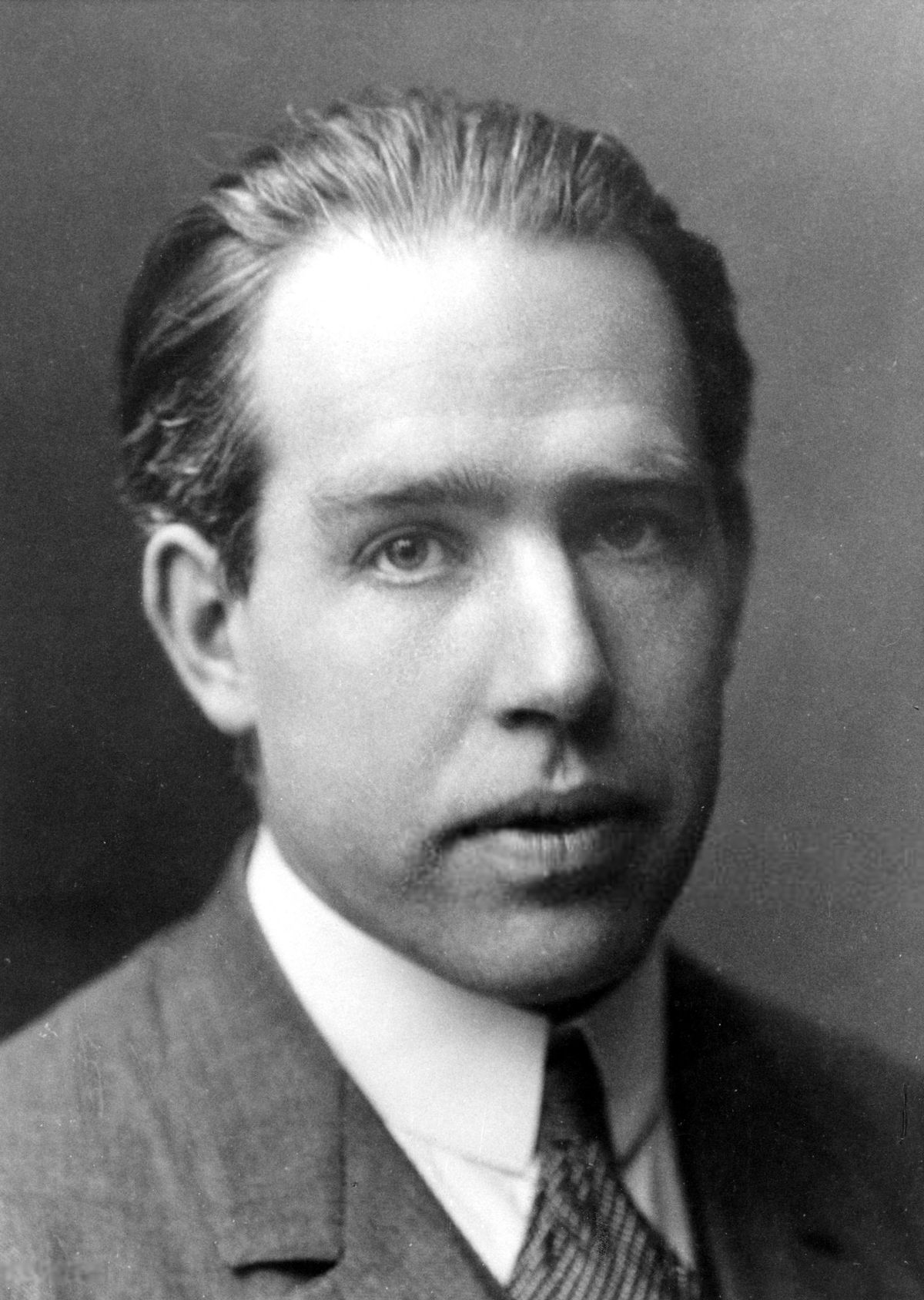
In 1913, Niels Bohr pictured the hydrogen atom as rings. Each ring is an energy level.
You will drop one electron from ring to ring. Each drop gives off one photon.
Photo: AB Lagrelius & Westphal, about 1922, public domain
PART 3 · QUESTION 9
Make the electron drop
1
Load H. Press One atom.
2
Uncheck Electron falls back down on its own. Now the readings stay put.
3
Press 3 to 2. The electron goes up, then drops.
4
Read the box at the top right. Copy the color, the wavelength and the energy.
5
Do 4 to 2, 5 to 2 and 6 to 2.
6
Last row: press 1 under Move the electron to level.
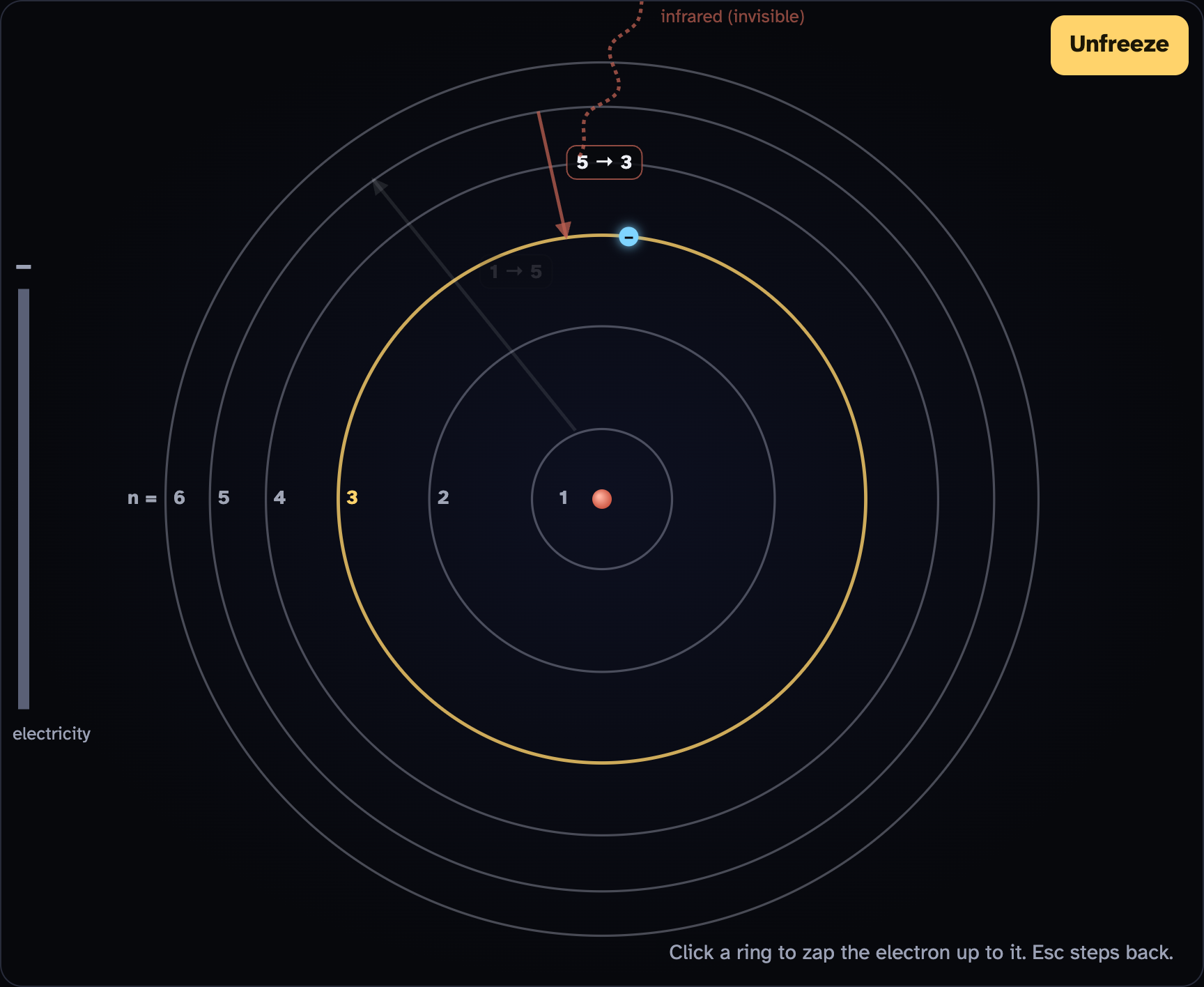
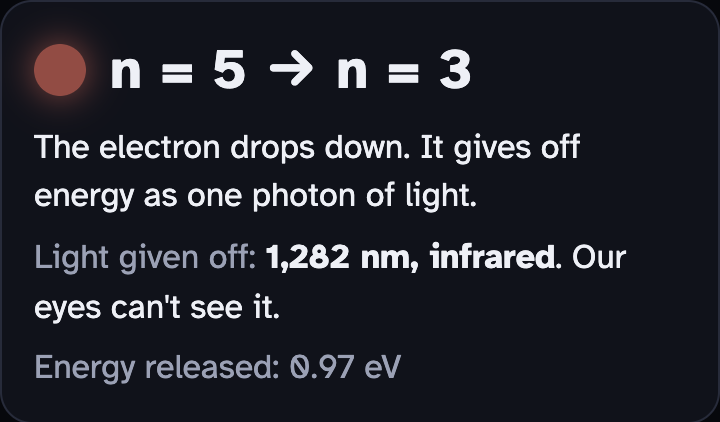
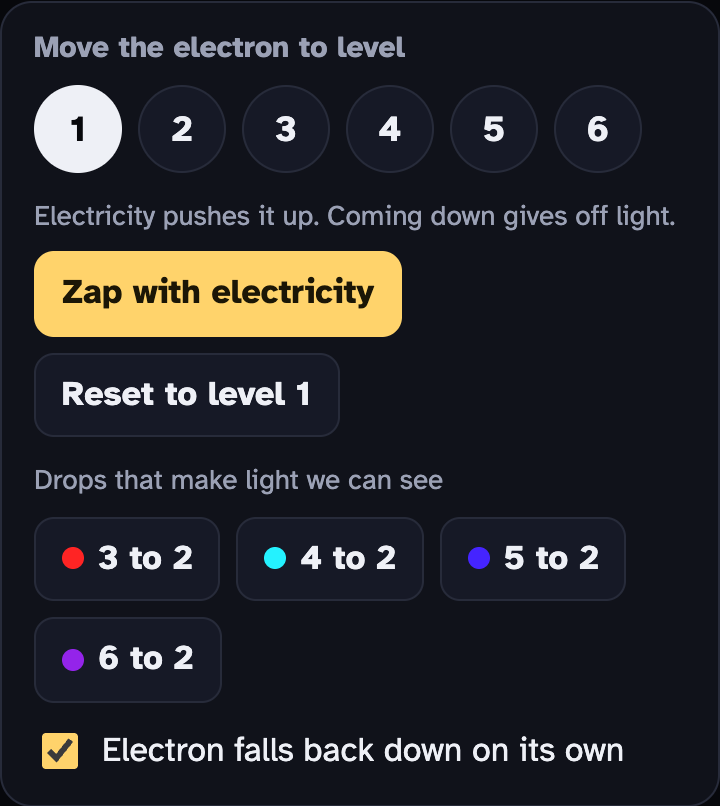
The pictures show a drop from 5 to 3. It is not in your table.
Leave Show wavelengths and colors checked.
Screenshots: mrsajdak.com/spectra, One atom
PART 3 · QUESTIONS 10 TO 12
Find the pattern
QUESTION 10
Multiply
Wavelength × energy
Do it for every row. Write it in the last column.
Read down the column. What do you notice?
QUESTION 11
Most
The biggest drop
Find the largest energy in your table. Which drop is it?
Could you see its light? Check the color you wrote.
QUESTION 12
Pattern
A bigger drop makes...
Compare a small drop with a big drop.
Does the energy go up or down? Does the wavelength get longer or shorter?
Example
500 × 2.00 = 1,000
A drop that gave 500 nm light and 2.00 eV. These are not your numbers. Use your own.
MYSTERY TUBE · QUESTION 13
Part 4. Mystery tubes
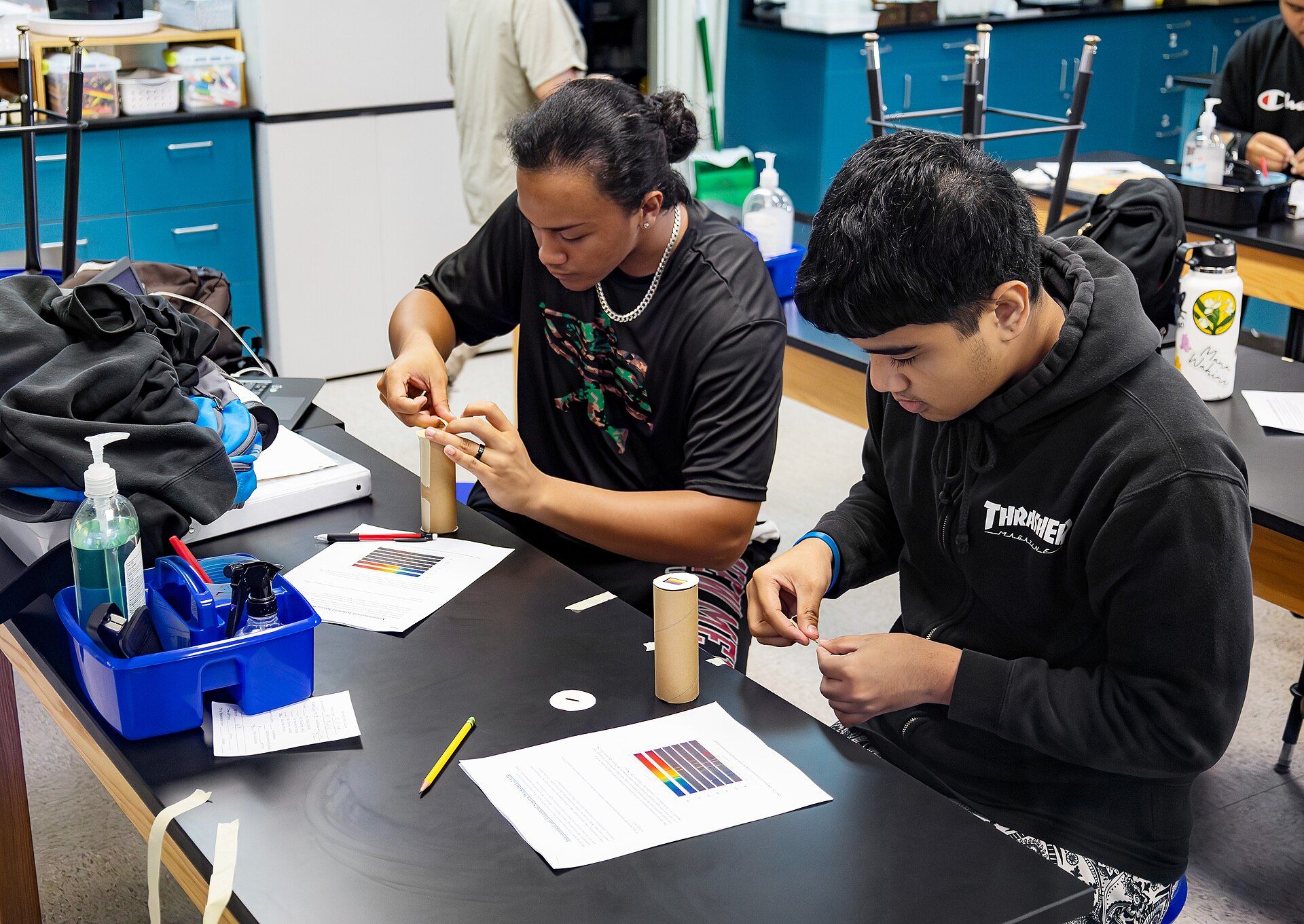
These students are building a spectroscope. It splits light into its colors.
You will get a gas with no label. Use its lines to work out what it is.
Photo: Gemini Observatory/NOIRLab/NSF/AURA/R. Sparks, CC BY 4.0
PART 4 · MYSTERY TUBE
Guess before you reveal
1
Press Mystery tube. Make sure the power is on.
2
Look at the glow. Then put on the glasses.
3
Write the lines you see. Give their colors and where they are.
4
Scroll down to the Fingerprints chart. Find the row that matches.
5
Write your guess. Then press Reveal.
6
Press Mystery tube again for Trial 2.
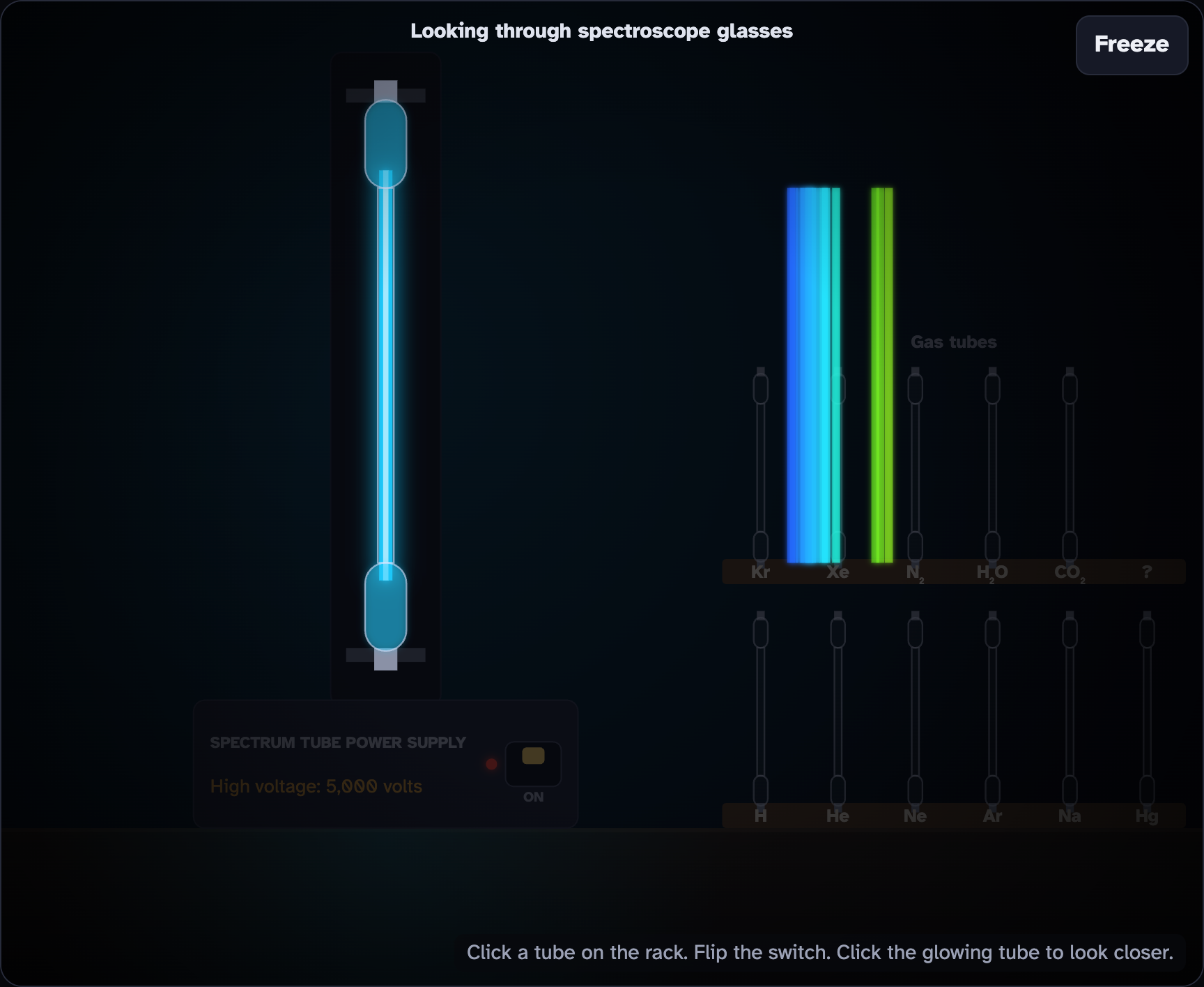

Reveal shows up only when a mystery tube is loaded.
You get a new gas each time. Your tube will not match this one.
One atom is turned off for a mystery tube.

Two rows of the Fingerprints chart. Which one matches the tube above?
Screenshots: mrsajdak.com/spectra, Mystery tube
PART 4 · QUESTION 13
Claim, evidence, reasoning
Claim
Pick one of your mystery tubes. Name the gas. “It was ____.”
Evidence
Name the lines that proved it. Give their colors. Say where they sit on the scale.
Reasoning
Say why those lines can only mean that gas. Think about what the Fingerprints chart shows for every element.
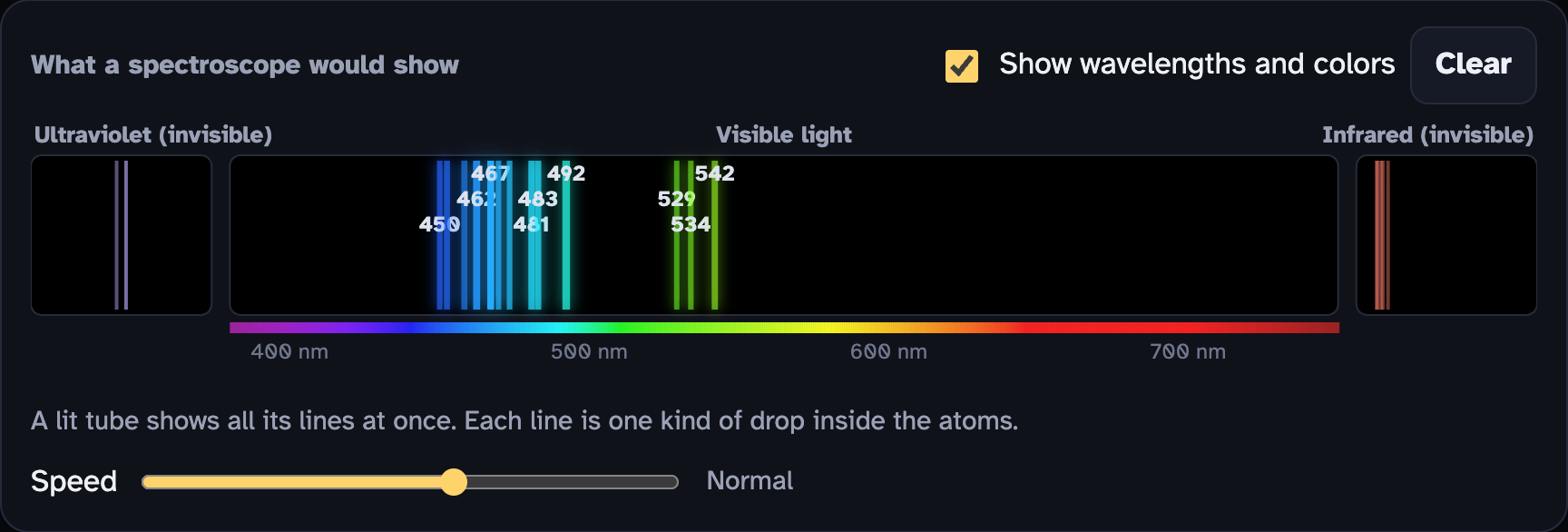
Example evidence
“I saw one bright orange line near 610 nm and three blue lines near 450 nm.”
These are not your lines. Use your own.
Screenshot: mrsajdak.com/spectra, Mystery tube
BENCH · QUESTIONS 14 AND 15
Part 5. More electrons, more colors
Hydrogen has one electron. Most atoms have many more.
Air is mostly nitrogen. Nitrogen gas is a molecule: two atoms joined together. It gives off light too.
Photo: NPS / Tim Rains
PART 5 · QUESTIONS 14 AND 15
Neon, then nitrogen
QUESTION 14
Count neon’s arrows
Load Ne. Turn the power on. Find the Energy levels box.
Each arrow is one drop. About how many are there?
Hydrogen has 1 electron. Neon has 10. What does that do to the levels?
QUESTION 15
An atom or a molecule?
Load N2. Put on the glasses. Look at the shape of each line.
Now load helium. Compare.
Go back to N2. Press Single atoms. Read the words at the top of the picture.
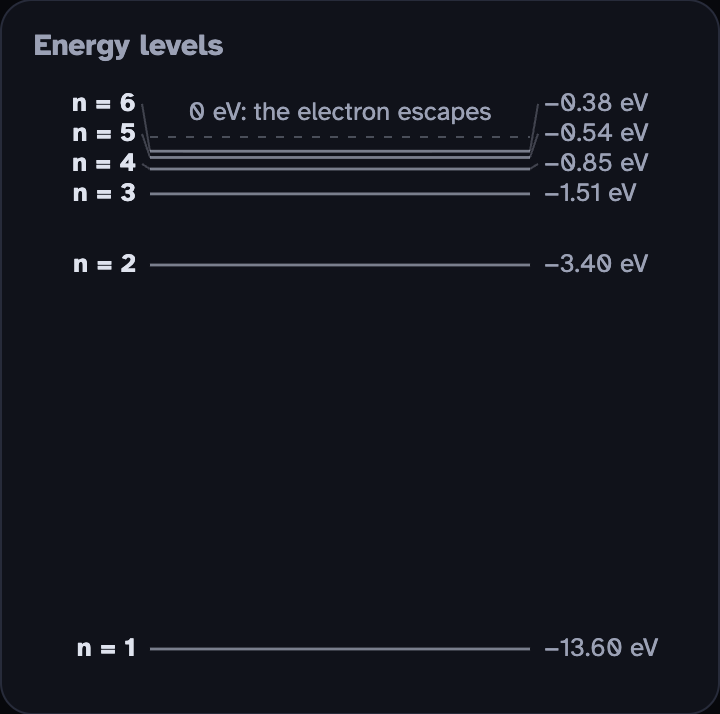
This is the Energy levels box for hydrogen with the power off. Neon’s looks very different.
Screenshot: mrsajdak.com/spectra, Energy levels
WRAP IT UP · QUESTION 16
How do we know what stars are made of?
The puzzle
No one has ever visited a star. But scientists know stars are mostly hydrogen and helium.
From Part 1
What did each gas show through the glasses? Did any two gases show the same thing?
From Part 4
How did you name a gas you could not see?
Your answer
Put it together. What can a scientist do with the light from a star?
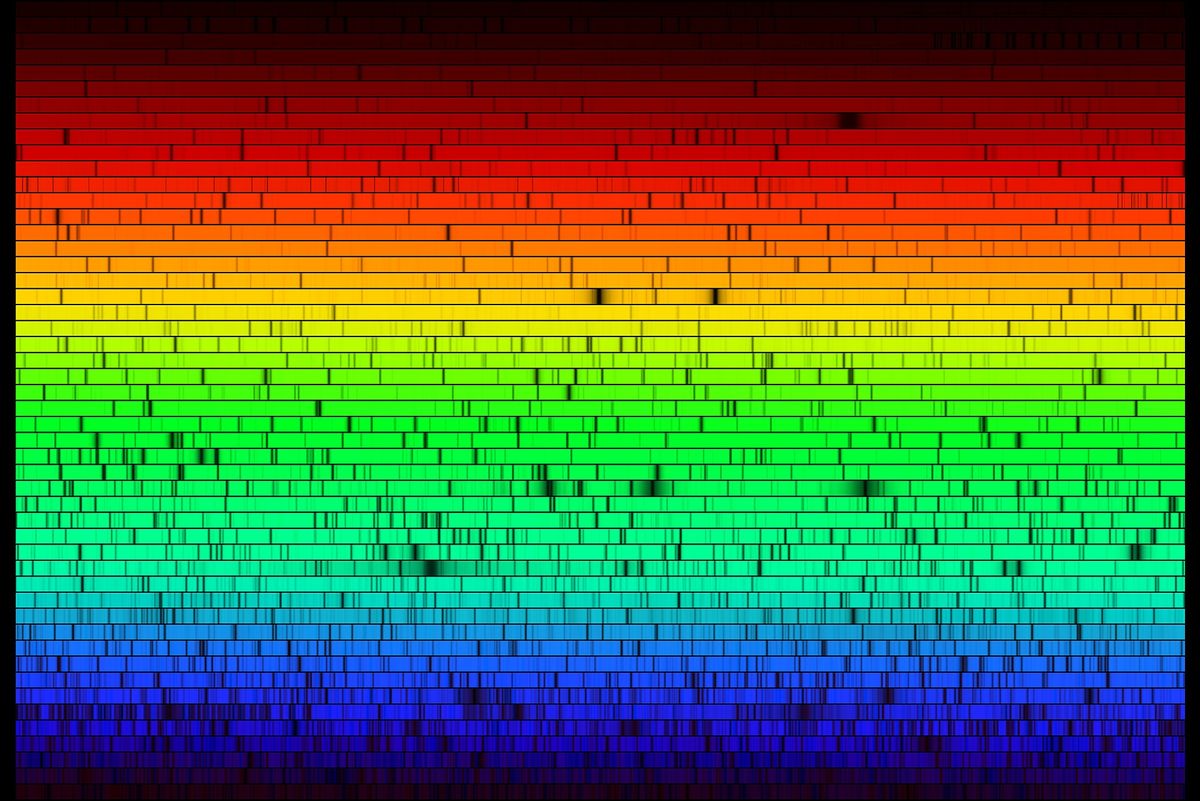
Sunlight, spread out into its colors by a spectroscope. Look at all the lines.
Photo: N.A. Sharp/KPNO/NOIRLab/NSO/NSF/AURA, CC BY 4.0
LAST CHECK
Before you hand it in
Name, date and period are on top.
Question 3 has four strips drawn and colored.
All three tables are full.
Question 13 has a claim, evidence and reasoning.
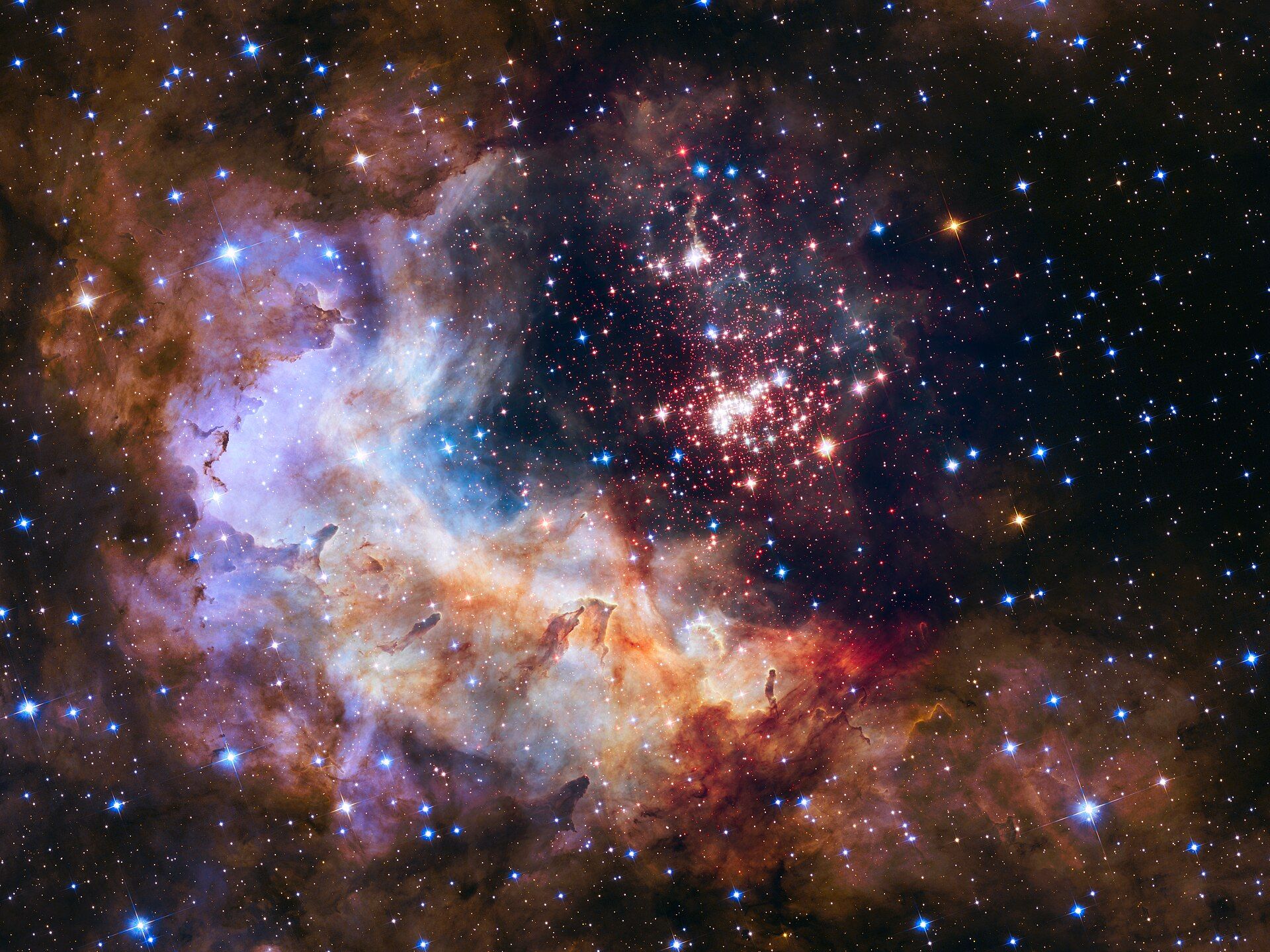
Photo: NASA, ESA, Hubble Heritage Team (STScI/AURA)